
Home > News
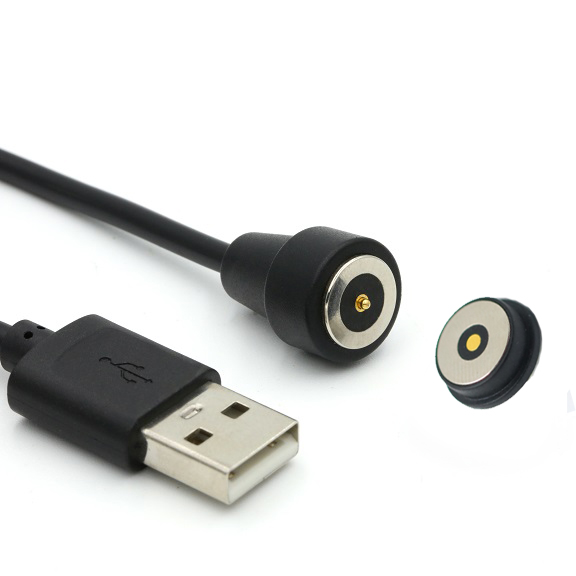
The magnetic charging cable is widely used due to its convenient plugging and unplugging feature. However, after being used for a period of time, problems such as the failure of fast charging and a sharp drop in charging speed often occur. It cannot maintain the original fast-charging power and usually falls back from several dozen watts to 5V ordinary slow charging. The main faults are concentrated in four aspects: loss of the magnetic connection head, reduction in the wire specifications, abnormal protocol matching, and damage caused by the usage environment.
The magnetic interface relies on exposed metal contact points to conduct current point-to-point. During daily use, sweat, oil, dust and cotton fibers from the hands will adhere to the gaps between the magnetic metal contact points. The salt components in sweat will gradually corrode the copper contact points, forming a grayish-white oxide layer. The oxide layer has an extremely high resistivity and significantly hinders the transmission of large currents. Fast charging requires continuous output of high current and high voltage, and when the contact resistance of the contact points exceeds the standard, the charging chip will automatically cut off the fast charging protocol to switch to a lower-speed charging mode of around 5V1A. In addition, the frequent attachment and detachment of the magnetic connector, as well as strong impacts, can cause the internal contact points to sink and deform. The contact points cannot be closely adhered, resulting in a reduction in the effective conductive area, and the large current required for fast charging cannot be stably passed through. Some inferior magnetic connectors have extremely strong magnets, and the impact force during the instant of attachment repeatedly squeezes the contact points, causing contact failure within a short period of time.
The core specification of the wire does not reach the load-bearing standard for fast charging. Regular fast charging wires need to have thicker copper cores and multiple strands of copper wires twisted together to reduce the wire resistance. For 66W and 120W fast charging data cables, there are strict requirements for the wire diameter and the number of copper strands. Most of the cheap magnetic suction cables on the market cut corners, using thin copper wires or even copper-clad aluminum materials for the wire core, resulting in extremely high internal resistance of the wire. During the transmission of current through the wire, a large amount of voltage drop occurs, causing the charger to output high voltage, which results in significant voltage loss when reaching the mobile phone end. The power IC of the mobile phone detects that the input voltage is insufficient and directly shuts off the fast charging. At the same time, the PCB circuit board space inside the magnetic suction heads at both ends of the inferior products is very small. The poor-quality products omit the stabilizing voltage and shunt components, and the long wire loss combined with the loss of the magnetic suction connector completely disrupt the conditions for fast charging. Some wire materials have their outer skins damaged, exposing the copper wires, causing hidden short circuits. The power adapter starts the current-limiting protection, further reducing the charging power.
The core specification of the wire does not reach the load-bearing standard for fast charging. Regular fast charging wires need to have thicker copper cores and multiple strands of copper wires twisted together to reduce the wire resistance. For 66W and 120W fast charging data cables, there are strict requirements for the wire diameter and the number of copper strands. Most of the cheap magnetic suction cables on the market cut corners, using thin copper wires or even copper-clad aluminum materials for the wire core, resulting in extremely high internal resistance of the wire. During the transmission of current through the wire, a large amount of voltage drop occurs, and the charger outputs high voltage, but the voltage at the phone end is significantly reduced due to substantial voltage loss. The phone's power IC detects insufficient input voltage and directly shuts down the fast charging. At the same time, the magnetic suction cable's two ends have internal PCB circuit boards with limited space. Thirdly, the fast charging protocol is incompatible, and the magnetic suction chip malfunctions, resulting in the failure of fast charging handshake. Fast charging relies on the protocol handshake recognition among the charger, data cable, and phone to achieve high-voltage fast charging. The integrated protocol recognition chip in the magnetic suction connector is compromised, and low-quality magnetic suction cables can only recognize the common 5V charging. Even if the original fast charging head is paired with the original phone, when connected to a faulty magnetic suction cable, the chip cannot complete the protocol communication, and the device determines that the external accessory does not support fast charging, and automatically switches to normal charging. Long-term high-temperature charging will burn out the small IC components inside the magnetic suction connector, and after the chip fails, it permanently loses the protocol recognition ability. Additionally, some magnetic suction cables add unstable voltage chips, which deteriorate in performance after heating and become unstable in power supply. The fast charging handshake repeatedly interrupts, resulting in fast charging sometimes being fast and sometimes slow, and eventually completely switching to normal charging.
In high-temperature environments and when charging while playing, the magnetic connection head will remain at a high temperature, accelerating the oxidation of metals and the aging of internal components. Mixing non-original low-power charging heads will result in the charger not having sufficient output power, and thus being unable to trigger fast charging. Dust accumulation and deformation at the tail plug of the mobile phone can also adversely affect the efficiency of magnetic charging. If the contact points of the charging port are dirty, even if the magnetic connection end is intact, the overall circuit impedance will increase, and fast charging will not be activated. There are also some magnetic charging cables whose magnetic heads are too thick. When connected to the mobile phone, they will squeeze the tail plug, causing contact deviation and hidden breaks in the internal circuits.
To restore fast charging, it is necessary to regularly use a dust-free cloth dipped in alcohol to wipe the magnetic metal contacts, avoiding the accumulation of oil stains; choose magnetic charging cables with thicker wires and equipped with genuine fast-charging chips to avoid low-priced and inferior products; stay away from environments with high temperatures for charging, and reduce charging while using; from the source, delay the aging and wear of the cables.
Contact: Jerry_Shi
Phone: +86-13652508770
Tel: +86-13652508770
Email: [email protected]
Add: LianFeng Road,XianXi Village,ChangAn Town,DongGuan City,GuangDong Province,China