
Home > News
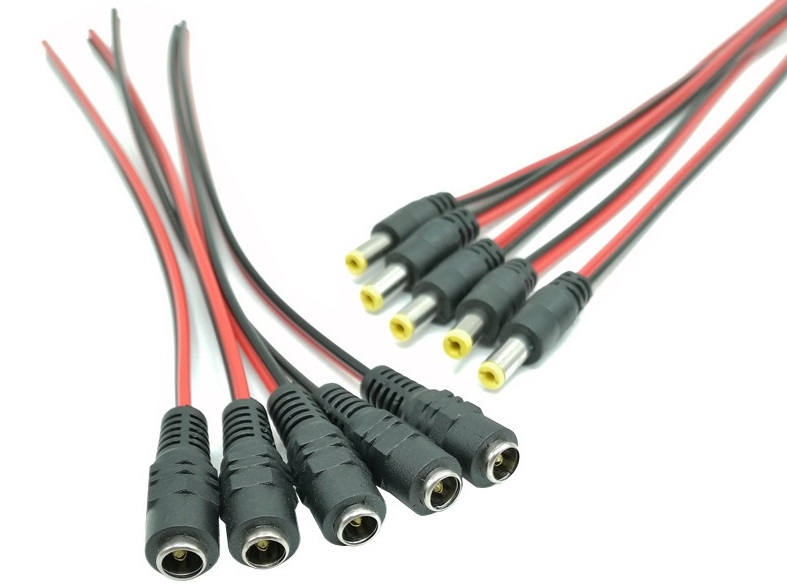
DC cables are divided into two concepts: the commercial warranty period and the physical natural service life. These two cannot be confused. The warranty periods for consumer-grade, industrial-grade, and special DC cable for photovoltaic applications vary greatly in the market, being directly affected by the material, usage environment, and load conditions. Below, we will comprehensively explain this in accordance with industry standards, manufacturers' after-sales rules, and aging patterns.
1. Official warranty period for conventional DC cables on the market
Consumer electronic universal DC power cords (router, surveillance equipment, light strips, small household appliances with 5.52.1/5.52.5 plug cables) are the most common category in the market. Ordinary e-commerce OEMs and low-end component manufacturers uniformly implement a 12-month warranty. From the date of receipt, faults such as non-human damage, overload burning, short circuit, open circuit, and faulty plugs can be replaced free of charge. For regular brands with 3C/UL certifications and DC cable assemblies, when supplied in bulk to equipment factories, the regular warranty period is extended to 18 to 24 months. For industrial automation and medical equipment, high-flexibility DC cable assemblies can negotiate a 3-year warranty, which is an industry standard high-level after-sales commitment.
High-power photovoltaic DC cables are special DC wires. The national standards and TUV certification standards clearly stipulate a design service life of 25 years. The written warranties provided by manufacturers generally indicate a 5-year warranty period. During the warranty period, insulation cracking, conductor oxidation, and non-compliance with voltage resistance can all be compensated for. For long-term outdoor installation scenarios, such long cables are the standard. While silicone industrial DC cable harnesses with high-temperature resistance, waterproof and oil-resistant properties have a manufacturer warranty of 2 to 3 years, suitable for strict working conditions of machine tools, vehicles, and outdoor equipment. There is no unified mandatory warranty period at the legal level. The product warranty is primarily based on the manufacturer's instructions and purchase-sale contracts. When there is no clear indication, the minimum warranty is 1 year, which is the industry standard warranty.
II. Physical Natural Service Life of DC cables
The warranty only covers the period for post-sale compensation. The actual aging lifespan of the wire is much longer than the warranty period. The high-quality TPE / national standard PVC DC wire with good indoor conditions, normal temperature, light load, and less bending can be used stably for 5 to 8 years. For wires that are frequently bent, plugged and unplugged daily, or placed close to heat sources, the insulation layer will gradually harden and crack after 3 to 5 years, and the plug welding points will oxidize and loosen. The low-quality recycled PVC wire has poor temperature resistance and will only last for 1 to 2 years under full-load operation before the outer skin becomes brittle and the copper wire inside breaks, posing a risk of short circuit and fire.
Industrial DC cables that are continuously powered for 24 hours, when the ambient temperature exceeds 60℃, the insulation material undergoes accelerated thermal oxidation, and the lifespan is directly halved. Outdoor unprotected DC cables are eroded by ultraviolet rays, rain, and temperature differences. The ordinary PVC sheath cracks within 2 to 3 years. To extend the service life, it is necessary to select a UV-resistant modified material. Silicone special DC cables have a temperature resistance range of -40℃ to 200℃, with outstanding anti-aging performance, and can be used stably for over 10 years. They are mostly used for wiring inside high-temperature equipment.
III. Key Factors for Significantly Reducing the Warranty Period and Service Life of DC Cables
The first issue is excessive heat. The wire diameter is too small and the equipment operates at full power for a long time, causing the conductor to continuously heat up and damage the insulation layer. Within three years, the insulation resistance drops sharply. Even if it is still within the warranty period, it will lose the warranty eligibility due to human overload. The second issue is mechanical damage. Repeated bending, dragging, and squeezing can cause the copper wire in the core to break. Stress cracking at the tail of the plug is the most common fault for DC cables, and human damage is not covered by the warranty. The third issue is harsh environmental conditions. High humidity, acids, alkalis, oil stains, and direct sunlight will accelerate the aging and oxidation of the sheath, significantly shortening the usable lifespan of the wire. The fourth issue is improper storage. Long-term storage in a sealed and humid environment, with the metal pins of the plug rusting, leads to poor contact after power-on. This is also not covered by the warranty compensation.
IV. Purchasing and Using Extension DC Cables for Extended Usage Period
When purchasing, prioritize choosing DC cables with formal certifications, TPE or silicone insulation. For industrial scenarios, it is advisable to request the manufacturer to extend the warranty period to more than 2 years. During use, avoid long-term overloading and close contact with heat sources. Reduce frequent bending and install protective sleeves outdoors. Once the physical lifespan reaches the critical point, even if the appearance is undamaged, it is recommended to replace it to prevent insulation failure from causing short circuits, burning the adapter and terminal equipment.
In summary, the official warranty period for ordinary consumer DC cables is 1 year, for brand industrial DC cables it is 2 to 3 years, and for special DC cables for photovoltaic applications, it is 5 years. In an indoor and mild environment, high-quality cables can actually be used for 5 to 8 years, while in harsh conditions, the lifespan is reduced to 2 to 3 years. By distinguishing between warranty periods and natural lifespans and making reasonable selections and proper usage, the safe usage period of DC cables can be maximized.
Contact: Jerry_Shi
Phone: +86-13652508770
Tel: +86-13652508770
Email: [email protected]
Add: LianFeng Road,XianXi Village,ChangAn Town,DongGuan City,GuangDong Province,China