
Home > News
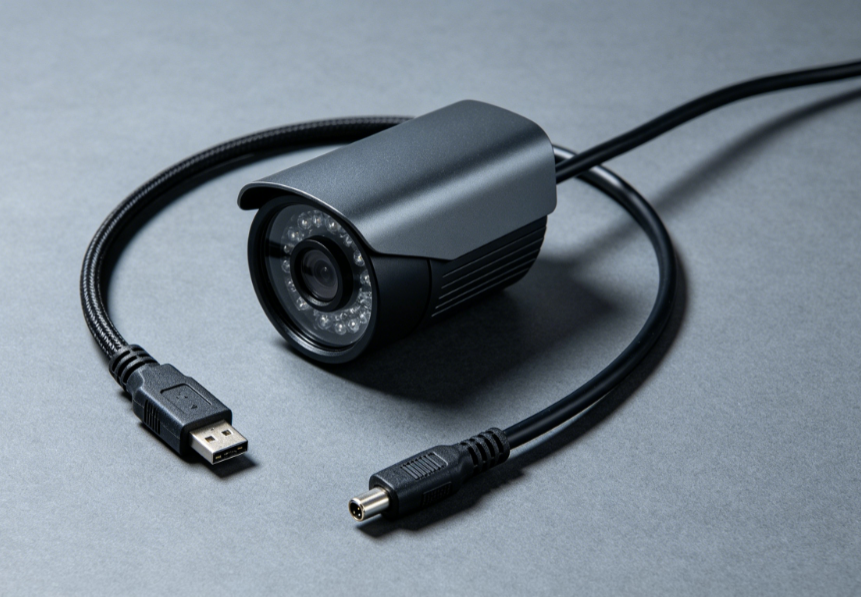
Video surveillance, live streaming cameras, and industrial imaging equipment demand extremely high stability in DC power lines. Incorrect cable selection can easily lead to issues such as screen flickering, failure of infrared night vision, device reboots, and voltage drop over long distances, significantly affecting video capture quality. Selecting a suitable DC cable requires comprehensive evaluation across five dimensions: conductor gauge, material, connector type, insulation jacket, and application environment. Below, we will detail the selection criteria based on the power supply characteristics of video equipment.
The core criterion for judgment is the cross-sectional area of the wire core, which is the key to solving the problem of voltage drop. Video devices are divided into indoor small cameras, 4G dome cameras, infrared high-speed dome cameras, and multi-channel centralized power supply camera units. The power differences are significant. Indoor home network cameras have a power mostly within 5W, with a working current of around 0.5A. For short distances of 5 meters, 22AWG (0.3 square) wire materials can be selected; outdoor infrared gun cameras and cameras with supplementary lighting have a power of 10–15W and a current of 1–1.5A. For distances within 10 meters, 20AWG (0.5 square) is recommended; for distances over 15 meters, long-distance wiring, high-speed dome cameras, and pan-tilt cameras, the working current can reach 2–3A. In this case, 18AWG (0.75 square) or even 16AWG (1 square) thick wire cores must be selected. The thinner the wire and the longer the distance, the greater the voltage loss. When the voltage drop of a 12V power supply line exceeds 0.8V, the camera may experience insufficient night vision light, cloud platform stalling, and video recording interruption. Therefore, for long-distance wiring, it is preferable to increase the wire core specification rather than blindly pursuing thinner wires to reduce costs. The wire material must be pure oxygen-free copper. Poor-quality copper-clad aluminum wire has poor conductivity and an internal resistance more than three times that of pure copper, and it is prone to overheating. In outdoor high-temperature environments, there may even be safety hazards. When purchasing, the wire can be bent to check its flexibility; pure copper wire is soft and not prone to breaking, while aluminum wire becomes hard and prone to discoloration and breakage.
The next aspect is the compatibility of DC interface specifications and the durability of the structure. The mainstream power supply interfaces for video devices are 5.52.1mm and 5.52.5mm. These two interfaces cannot be used interchangeably. If the inner diameter of the interface does not match, there will be poor contact, and even slight vibration will cause power interruption, resulting in loss of video recording. Industrial-grade dome cameras mostly use DC male-female connectors with locks. For outdoor and open-air scenarios, it is necessary to select cables with threaded locking structures. Ordinary straight-insert DC cables are prone to falling off in windy and rainy conditions. The internal metal spring clips need to be thickened with gold-plated brass. The gold plating layer can resist oxidation and prevent copper from oxidizing and turning black in outdoor humid environments, avoiding unstable power supply. Cheap interfaces without gold plating will experience an increase in contact resistance after three months of use, causing periodic flickering of the picture. At the same time, the direction of the outgoing wires from the male connector should be distinguished. Wall-mounted cameras are suitable for straight DC cables, while ceiling-mounted embedded equipment should choose 90-degree bent DC cables to avoid the bending and squeezing of the internal copper wires. Long-term bending will cause the core wire to break.
Thirdly, the type of sheath material should be selected based on the usage environment, which can be divided into three categories: indoor, outdoor waterproof, and high-temperature industrial. For indoor normal temperature environments, PVC sheathed DC cables can be chosen, as they are cost-effective and have good flexibility; for outdoor outdoor monitoring wiring, PVC + rubber double-layer sheaths must be used. The preferred option is to select DC connectors with IP65 waterproof injection molding that are integrated, as ordinary splicing connectors may cause short circuits and damage equipment when water seeps in. For monitoring in gardens, construction sites, and open parking lots, TPU elastic sheathed cable materials are recommended. They are resistant to ultraviolet aging and will not crack or harden under long-term sun exposure; for refrigerated storage and high-temperature machine rooms with camera equipment, silicone high-temperature-resistant sheathed DC cables should be selected. They can withstand a temperature range of -40°C to 120°C. Ordinary PVC will become hard and brittle at low temperatures and soften and deform at high temperatures. In scenarios where wiring needs to pass through walls or metal pipes, the sheath must have anti-compression and anti-wear properties to prevent the insulation layer from being scratched by metal spikes on the wall, causing a short circuit.
The fourth auxiliary performance selection includes requirements for shielding, extension, and shunt. When live-streaming equipment and high-definition industrial cameras transmit images, there are routers, transformers, and high-voltage lines around, and electromagnetic interference can cause the images to have horizontal stripes and more noise. In such scenarios, double-shielded DC cables must be selected. The inner layer is wrapped with aluminum foil, and the outer layer is a braided copper mesh for grounding, to isolate electromagnetic interference. When multiple video devices are centrally powered, do not parallel multiple thin wires; instead, use a one-to-two or one-to-four DC cable with voltage regulation and shunt, with each branch having independent copper cores to avoid overloading and overheating of a single thin wire carrying multiple currents. The length of the cables should be selected as needed, and do not over-reserve long cables; excess cables should be wound to avoid forming inductance amplification interference. When using long cables, the wire core specifications must be upgraded simultaneously to counteract voltage drop.
Finally, identify inferior cables to avoid pitfalls. Market-priced DC cables often falsely label the wire gauge. For example, a 20AWG label may actually only indicate 24AWG. You can use a caliper to measure the diameter of the copper core to verify this. At the same time, check the insulation layer thickness. Thin-paste cables have poor insulation and are prone to leakage. For long-term engineering use, prioritize DC power cables with 3C certification. Home live-streaming equipment should also avoid unmarked, unqualified, and unidentifiable products.
In summary, the logic for selecting video DC cables is clear: first, calculate the working current of the equipment and the distance of the wiring to determine the thickness of the copper core, then match the corresponding DC interface structure, combine with indoor and outdoor environments to select the material of the sheath, add a shielding layer when there is electromagnetic interference, and balance durability and power supply stability. This can ensure the continuous and stable operation of video equipment and reduce the cost of later fault repair.
Contact: Jerry_Shi
Phone: +86-13652508770
Tel: +86-13652508770
Email: [email protected]
Add: LianFeng Road,XianXi Village,ChangAn Town,DongGuan City,GuangDong Province,China