Why does a magnetic charging cable intermittently disconnect during charging?
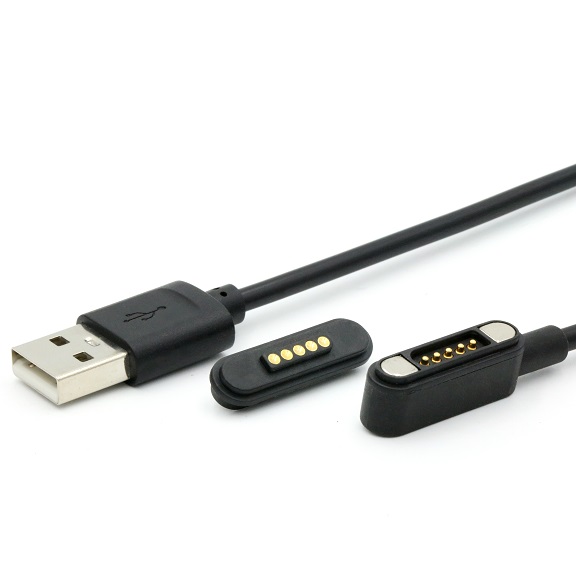
Intermittent and repeated disconnection during magnetic charging is a common issue in daily use, with root causes primarily attributed to five factors: magnetic contact points, cable wear, device interfaces, power adapter compatibility, and foreign object interference. The problem can be systematically analyzed from physical contact down to circuit-level faults as follows.
1. Dirty or oxidized magnetic contact points are the most common cause (accounting for over 60% of failures).
Magnetic charging cable relies on positive and negative metal contacts to attract and conduct current. In daily use, dust, lint, hand oils, and sweat easily accumulate in the gaps between the metal plates of the magnetic ring. When oil mixes with dust, it forms an insulating grime that isolates the conductive metal layers. Although the magnet appears securely attached, the contacts intermittently connect and disconnect. During charging, current flow generates heat, causing the grime to slightly deform and temporarily restore contact; once cooled, the contacts separate again, resulting in repeated disconnections and pop-up alerts. Prolonged exposure to humid environments—such as bathrooms or kitchens—causes oxidation and blackening of the metal contacts. The oxide layer has extremely high resistivity, leading to unstable conductivity after adhesion, and even minor vibrations can trigger intermittent charging. Some users habitually place the device carelessly, causing impacts that damage the metal plating. This exposes the underlying material to rust, further worsening poor contact.
II. Physical deformation of the magnetic base and decline in magnetic force
The magnetic base is embedded with permanent magnets. Long-term dropping, heavy pressure, and exposure to high temperatures will cause the magnets to crack and lose their magnetism, resulting in a decrease in the magnetic attraction force. Even slight shaking or the pull of the wire's own weight can cause a false connection. The original magnetic base has uniform magnetic force when it is出厂 (manufactured). The inferior and cheap magnetic base uses thin materials, and its magnetic force significantly declines after being used for several months. Minor gaps appear on the surface where the magnetic base adheres. At the same time, the injection-molded shell of the magnetic base warps due to heat, and the internal spring clips shift, preventing the contacts from fully adhering. It can still charge when left stationary, but immediately loses power when moved. Additionally, the welding joints inside the magnetic base may also come loose, causing false welding when the wire bends and pulls on the internal weld points, resulting in intermittent current.
III. Breakage of the copper core inside the charging cable and aging of the outer skin
The root part of the magnetic suction cable (where the wire body connects with the magnetic suction head and the USB connector) is a high-frequency bending area. After repeated bending of multiple strands of copper wires, some core wires break, and the remaining wires can barely conduct electricity. Under force stretching, they will break, and when relaxed and rebound, they will reconnect, forming a regular charging interruption. Inferior cable materials have thin wire diameters and no anti-tensile fibers. Within 1 to 3 months, internal wire breaks occur; high-quality cable materials will also break internally after repeated bending, twisting, and storage due to repeated bending. The outer skin of the cable cracks and gets wet, water vapor seeps into the wire core, causing local short circuits. The power chip triggers overcurrent protection and instantly cuts off power, and after a few seconds, it recovers and resumes charging.
IV. Equipment Tail Plug Interface Faults and Compatibility Issues
For mobile phones and digital products, the Type-C / Apple tail plug gets dusty and clogged, with the pins sinking in or loosening. After the USB male connector is inserted, the contact is not reliable, and the current transmission is unstable. The magnetic attachment end frequently disconnects. Some models have an aging internal charging IC in the tail plug, which has abnormal current recognition and frequently turns on and off the charging protection. At the same time, an incompatible charger power also triggers the disconnection of charging: when a fast charging magnetic attachment cable is paired with a low-quality generic charger, the voltage output fluctuates greatly, and the power module detects an abnormal voltage and automatically shuts down; when a high-power fast charging head is paired with an ordinary magnetic attachment cable, the wire fails to carry the current and triggers overheating protection, with intermittent power-off for cooling. Incompatible non-original magnetic attachment protocols lead to failed fast charging handshake, and the device repeatedly reconnects to negotiate the charging protocol, resulting in a visible phenomenon of disconnection during fast charging.
V. Environmental Temperature and Usage Habits Accelerate Failures
High-temperature conditions (such as leaving the phone in direct sunlight or charging it in the bed) cause the magnetic metal to expand and contract, resulting in magnetic loss and changes in contact gap; in low-temperature conditions, the metal contracts, causing the fitting gap to widen. While charging, using the phone, pulling the wire, or casually dragging the magnetic attachment, continuous pulling and tensioning accelerate the deterioration of the false connection failure. Some magnetic attachment cables with data transmission have data pins that short-circuit and interfere with the power circuit, causing the control system to misjudge and power off abnormally.
VI. Summary of Simple Solutions
First, use an alcohol swab without water to wipe the contact points of the magnetic attachment and the device interface, removing oil and dust. If the magnetic force is insufficient, replace the magnetic head directly. If the wires are frequently bent and cause power failure, replace the entire wire. Choose an original and compliant charger to avoid using inferior fast chargers. In daily use, avoid bending the storage wires and using them in high-temperature and humid environments, which can significantly reduce the probability of power failure.