
Home > News
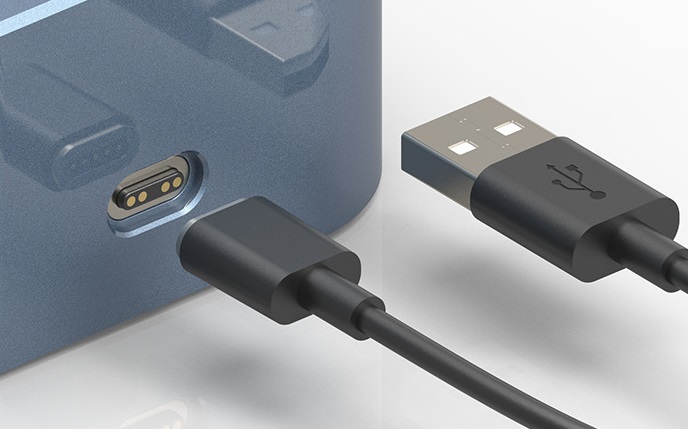
The magnetic charging cable is highly favored due to its advantages of no need for unplugging and protection against drops. However, it generally has problems such as short lifespan, easily damaged connectors, and a much higher failure rate than ordinary data cables. Most magnetic charging kits experience faults like magnetic force decline, poor contact, cracking of the cable, and internal short circuits within a few months of use, making them unable to charge properly. The main reason is not simply due to usage wear and tear, but rather is caused by the specific design flaws of the magnetic structure, industry material reduction, unreasonable force application, and circuit compatibility issues. Compared to traditional plug-in data cables, there are inherently more loss shortcomings. The specific reasons are as follows.
The special magnetic detachable structure is its inherent weak point that is prone to damage. Ordinary data cables have an integrated and sealed structure, with the conductive contacts hidden inside the connector, providing extremely strong sealing and stability. However, the magnetic charging adopts a separate magnetic head and cable structure, with the metal conductive contacts completely exposed outside, without any protection or shielding. During daily use, the contacts directly come into contact with air, dust, sweat and oil, which easily leads to oxidation and blackening, as well as accumulation and blockage, resulting in a decline in conductivity. At the same time, the exposed metal contacts have extremely poor wear resistance. Repeated adsorption and slight friction will wear off the surface coating, and once the coating is removed, the substrate is very prone to rust and corrosion, directly causing contact failure. This is the primary reason for the premature failure of the magnetic connector.
The poor quality of the magnetic core components and the reduced craftsmanship are the key factors contributing to the short lifespan. Most of the affordable magnetic suction cables on the market have seriously compromised quality due to cost-cutting measures. The internal magnets are mostly of inferior ordinary magnetic powder cores, with low magnetic flux and poor stability. When continuously powered on, they will heat up, and after daily heavy pressure and exposure to the sun, they will quickly experience demagnetization and magnetic force attenuation, leading to loose adhesion and false connection faults. At the same time, the internal solder joints of the magnetic suction heads are very small and thin. They are only fixed by a small amount of solder to the wire contacts, without being wrapped with reinforcing glue. Even a slight pull will cause false soldering or detachment. Moreover, the copper core wire diameter inside the cable is insufficient and the number of strands is scarce. Their conductivity and tensile strength are extremely poor, unable to withstand long-term current transmission and bending losses. They are far inferior to the material standards of the original ordinary data cables.
The special force application method accelerates the aging and damage of the wire and the connector. Traditional data cables concentrate the force at the root of the connector, while the magnetic attachment cables' force points are entirely concentrated on the magnetic attachment contact surface. During daily use, factors such as the placement, movement, flipping, bumping, and self-weight pulling of the mobile phone, all cause the magnetic attachment connector to continuously bear shear force and tension. Even slight vibrations in the attached state will repeatedly wear down the contacts and loosen the internal solder joints. Over time, this will lead to intermittent failures. At the same time, users' habit of bending and winding to store the wire causes repeated bending at the connection point between the magnetic head and the wire body. The internal weak copper core is prone to breaking, and the outer skin will quickly crack and deteriorate. This is the core reason why magnetic attachment cables are more likely to break the core than ordinary cables.
Overheating and circuit losses create a vicious cycle that accelerates component damage. Magnetic charging relies on contact between contacts to conduct electricity, and the contact surfaces have inherent resistance. During the charging process, heat is continuously generated. Moreover, most magnetic charging cables are incompatible with fast charging protocols. When used with high-power fast charging adapters, there will be situations of excessive current and abnormal protocol handshake, resulting in severe overheating of the magnetic charging head. High temperatures continuously dry out the internal magnets, solder joints, and insulation layers of the wires, causing the magnets to accelerate demagnetization, solder to melt and become poorly soldered, and the plastic casing to age and become brittle. High temperatures damage the contact structure, and poor contact will further exacerbate overheating, forming a vicious cycle of "overheating - poor contact - more overheating", significantly shortening the lifespan of the entire equipment.
The usage environment and operating habits further exacerbate the wear and tear and eventual failure. Daily dust and cotton fibers easily adhere to the gaps of the magnetic metal contacts, making them difficult to clean thoroughly. Over time, the accumulation will corrode the contacts. The humid environment in bathrooms and kitchens will accelerate the oxidation of the metal and the corrosion of the internal circuits. At the same time, many users charge their phones while using them, constantly pulling the magnetic connector, and the continuous force causes the already fragile split structure to continue to deteriorate. In addition, the magnetic head is often inserted into the phone's tail connector, which is prone to being squeezed and bumped, causing the tail connector to deform, the magnetic head contacts to shift, and ultimately resulting in complete damage and inability to use.
Therefore, the short lifespan of magnetic charging cables is the result of multiple factors such as structural flaws, poor material quality, unreasonable force application, heat loss, and wear and tear during use. Their split and exposed structure inherently makes their durability much lower than that of traditional data cables. Coupled with the common low-cost manufacturing processes in the industry, this ultimately leads to the frequent failure of magnetic connectors and the short lifespan of the cables becoming a common phenomenon.
Contact: Jerry_Shi
Phone: +86-13652508770
Tel: +86-13652508770
Email: [email protected]
Add: LianFeng Road,XianXi Village,ChangAn Town,DongGuan City,GuangDong Province,China