What is the maximum voltage that the LVDS Cable can handle?
Maximum Voltage of LVDS Cables
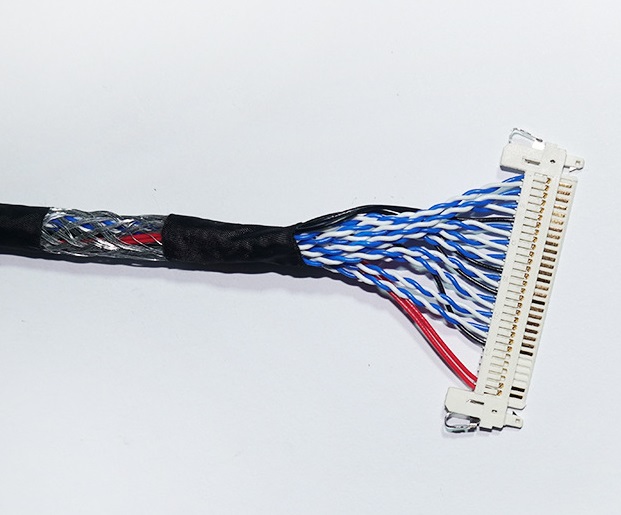
We need to separate two concepts:
-
Signal operating voltage (LVDS differential signal itself)
-
Wire insulation withstand voltage (cable dielectric rated voltage)
-
Power pins voltage carried inside the same LVDS harness (VCC / Backlight)
1. LVDS Differential Signal Working Voltage (TIA/EIA-644 Standard)
|
Parameter
|
Spec Value
|
Explanation
|
|
Differential swing between pair wires
|
250 ~ 450 mV (typ 350 mVpp)
|
The actual signal voltage difference for data transmission
|
|
Common-mode DC offset voltage
|
1.2 V typical, range 0 ~ 2.4 V
|
DC bias reference to GND on each signal wire
|
|
Max safe input voltage to receiver chip
|
≤ 2.4 V DC
|
Over 3.5 V will burn the LVDS receiver IC
|
LVDS is a low-voltage signaling standard; the high-speed data pairs only carry tiny mV-level differential signals, never high voltage.
2. Cable Insulation Withstand Voltage (All LVDS Cable Types)
This is the maximum voltage the wire jacket can resist without breakdown, factory test standard:
|
Cable Type
|
Rated Working Voltage DC
|
Hipot Test Voltage (1 min)
|
|
Standard FFC flat LVDS ribbon
|
60 V DC
|
250 V AC / 300 V DC
|
|
Twisted-pair shielded LVDS (STP)
|
300 V DC
|
500 V AC
|
|
Micro-coaxial LVDS (I-PEX)
|
300 V DC
|
500 V AC
|
|
High-temperature PTFE LVDS wire
|
600 V DC
|
1000 V AC
|
Key note: The insulation can withstand hundreds of volts for safety testing, but you cannot run high voltage on LVDS signal pins. Only power lines inside the harness can carry higher DC voltage.
3. Maximum DC Voltage Allowed on Power Pins Inside LVDS Harness
The
LVDS cable bundle integrates screen power & backlight lines; these pins can carry higher DC voltage limited by wire gauge and connector:
Common Allowed Power Voltages
-
LCD panel core VCC: 3.3 V / 5 V / 12 V DC (most industrial, laptop, advertising screens)
-
LED backlight power: 12 V / 24 V DC (standard large display)
-
Forbidden high voltage:
-
Do NOT run CCFL backlight high voltage (800~1500V AC) inside LVDS harness; use separate high-voltage wire
-
Do NOT feed over 24V DC to LVDS connector pins (FFC/I-PEX small pins have low creepage distance, risk short/arcing)
Current & Wire Gauge Matching Rule for Power Lines
-
28 AWG: Max 3 A (≤12V)
-
26 AWG: Max 5 A (≤12V/24V)
-
24 AWG: Max 8 A (24V backlight)
4. Critical Design & Customization Notes (For LVDS Cable Order)
-
Never route >24V DC through LVDS signal connectors (FFC 0.3/0.5mm, I-PEX fine pitch)
-
If you need to carry 24V backlight power inside the same LVDS cable:
-
Request thicker gauge power conductors (24/26AWG)
-
Separate power groups from differential signal pairs with ground shielding to avoid noise
-
LVDS differential data pairs strictly limit pin voltage under 2.4V DC; misconnecting 5V/12V to signal pairs will instantly destroy screen TCON chip
-
Insulation withstand voltage is a safety test index, not operational voltage limit for signal circuits
-
For automotive LVDS harness, power pins max operating voltage is 14V DC (12V vehicle battery system)
Quick Summary
-
LVDS data signal differential voltage: ~350 mV swing, 0–2.4V DC common-mode
-
Cable insulation breakdown tolerance: 250V~1000V AC (test only)
-
Safe operating DC voltage on power pins inside LVDS wire: Max 24V DC (recommended ≤12V for general displays)