
Home > News
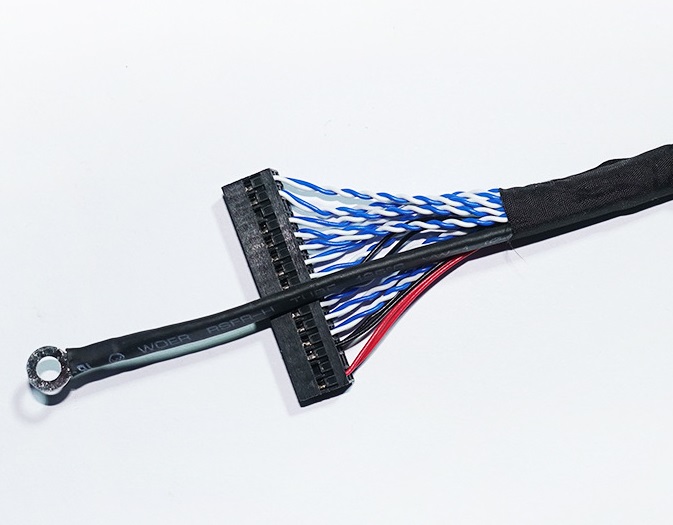
I. Pre-connection & Data Preparation (90% of sample failures are due to incomplete data)
1.First, provide the original sample wiring. Secondly, provide the complete specification document.
The safest way to customize LVDS cable for beginners, the safest option is to send the original factory-made wiring to the manufacturer for copying the wiring sequence, connectors, shielding, length, and bending process. This avoids errors in pin definitions that could cause black screens or colorful screens.
If there are no samples, the following must be provided: screen Datasheet pin definitions, motherboard socket specifications, wiring sequence table, indicating power, differential signals, EDID, GND, backlight control lines, and differentiating between positive and negative (LVDS P/N cannot be reversed).
It is prohibited to only report the number of P and the length, as the lack of pin definitions can easily lead to errors.
2.Precisely mark the complete part numbers of the connectors at both ends.
Distinguish brands: I-PEX, Hirose, JAE, DF13, FI-X, FFC flexible cable; Mark key details:
Pitch: 0.3/0.4/0.5/1.0mm; Up connection / Down connection, presence of locking mechanism, forward and reverse insertion, gold plating thickness;
FFC distinguishes the outlines on A side / B side, forward and reverse, single-sided / double-sided reinforcement plates;
The delivery cycle for imported connectors is long. Inquire in advance whether there are alternative domestic compatible sockets from the manufacturer to avoid delays.
3.Clarify the definition of total length to avoid size deviations
Standardize the approach: refer to the center-to-center length of the connector, rather than just saying "outer skin length";
Reserve assembly margin: reserve 10–30mm buffer for wire routing inside the chassis; for scenarios with frequent bending, add extra length; strictly prohibit pulling or tugging the wires.
II. Wire Selection & Shielding Selection (Determining whether the picture will have snowflakes and the anti-interference capability)
1.The three types of LVDS cables must not be mixed together.
| Cable Type | Application Scenarios | Key Considerations |
|---|---|---|
| FFC Flat Ribbon Cable | Standard displays, short distance < 30cm | No shielding = susceptible to interference; not recommended for industrial/automotive use; must add conductive cloth shielding for longer distances |
| STP Twisted Pair Differential Cable | Industrial displays, advertising machines, medium distance | Must be pair-twisted; controlled 100Ω differential impedance |
| Micro-Coaxial Cable Harness | 4K/8K high-definition, automotive, long distance > 50cm, high-EMI environments | Independent coaxial shielding; strongest EMI suppression; highest cost |
LVDS standard differential impedance: 100Ω ± 5%, for high-speed screens: ±3%;
The manufacturer is required to provide a TDR impedance test report for shipment. Failure to control impedance will inevitably result in screen flickering, horizontal stripes, and snowflakes.
3.Internal equal-length control for differential pairs (key pit avoidance point)
Basic screen: Error within differential pairs ≤ 5mm; 4K high-definition / in-vehicle screen ≤ 3mm;
There are no strict requirements for the length difference between differential pairs, but they must be of equal length internally; otherwise, the signal timing will be disrupted and the screen will go black.
4.Shielding is selected on a case-by-case basis according to the requirements.
Indoor general equipment: single-sided conductive fabric + single-ended grounding;
Industrial control, near power supply, motors: double-sided conductive fabric, both ends fully grounded;
Vehicle-mounted, medical, high-power equipment: copper foil fully wrapped + woven net double-layer shielding, 360° grounding;
If only one end of the shielding layer is grounded, interference will be introduced. High-frequency equipment must be grounded at both ends.
III. Electrical, Temperature Resistance and Flexibility Requirements
1.Temperature-resistant wire classification
Normal indoor temperature (0–80℃): Regular PVC electronic wire, low cost;
Equipment inside a sealed environment with high temperature, vehicle-mounted (-40~105℃): Teflon high-temperature wire;
Fire / medical equipment: Low smoke halogen-free LSZH, does not release toxic smoke when exposed to open flames;
2.The bending resistance life is clearly indicated.
Fixed installation without movement: Ordinary wire can be used;
Touch screens, flip cover devices, motion mechanisms: High-flexibility wire, requires continuous core without breakage after 50,000/100,000 bends. The outer layer is reinforced with woven mesh tube and acetate fabric.
3.The current carrying capacity cannot be ignored.
For the backlight and power supply pins, confirm the voltage and current, and ensure the wire diameter matches: 28AWG for small current, 24/22AWG is used for the backlight's high-power power supply. Fine wires that carry large currents will generate heat.
IV. Key Requirements for Production Process & Welding Quality Inspection
1.Fine pitch connectors prohibit manual spot welding.
0.3/0.4mm ultra-small I-PEX joints must be welded using a hot press welding equipment; manual welding is prone to poor soldering and short circuits, and long-term use will result in poor contact and screen flashing.
2.Shielding grounding process specification
The conductive cloth, copper foil, and woven mesh need to be fully welded and connected to the ground wire; they cannot be simply wound; the manufacturer must provide grounding conduction testing.
3.Full inspection must be conducted at the factory and included in the purchase agreement.
Basic inspection: 100% conduction, short circuit, and wire sequence testing;
High-end products: random testing of TDR impedance, bending test, high and low temperature aging, and EMI interference testing;
Refuse small workshops without testing for direct shipment, as the cost of batch rework due to defects is extremely high.
V. Production, Samples, Costs and Delivery Schedule Notes
1.During the sample stage, it is essential to conduct actual testing on the machine before mass production.
For the sample, 2-5 pieces are made and the entire machine is powered on for 4-24 hours for testing. Observe for any screen flickering, horizontal lines, black screen, or thermal failure.
Confirm that everything is correct and sign the product acceptance certificate (including drawings and sample signatures). The bulk production must strictly follow the acceptance certificate; without the acceptance certificate, the manufacturer is allowed to modify the process at will and will not provide after-sales service.
2.The sample fee and mold cost should be agreed upon in advance.
Standard general connectors have no mold fee; non-standard special connectors and special fixtures will incur mold fees. It is agreed whether the sample/mold fee will be refunded after the batch order is placed.
3.Order quantity and delivery time risks
For small-scale R&D orders (1-100 pieces), only small-scale wiring factories can be chosen; for automotive-grade and medical-grade manufacturers, the order quantity is high;
The delivery time for imported connectors is 15-45 days. For projects in a rush, confirm the material inventory in advance and, if necessary, replace with domestic substitutes.
4.Price traps distinction
Low-price manufacturers often reduce the gold plating thickness, simplify the shielding, do not control impedance, and replace high-temperature and high-flexibility wires with ordinary ones; when comparing prices, not only the unit price should be considered, but also the material, testing standards, and gold plating specifications should be verified simultaneously.
VI. Certification Compliance (Export / Industrial / Vehicle Mandatory, Please Specify in Advance)
1. Domestic ordinary complete machines: Basic ROHS environmental protection, all factories are equipped with it;
2. Export to Europe and the United States: UL wire and cable certification, REACH hazardous substance testing;
3. Industrial equipment: ISO9001, in line with IPC-A-620 wiring harness industry standards;
4. Vehicle central control: Must have IATF16949 vehicle-specific certification, CISPR25 vehicle anti-interference report;
5. Medical imaging equipment: ISO13485, low smoke, halogen-free, flame-retardant wire and cable;
Products without corresponding certifications cannot pass the complete machine inspection, and the complete machines will be deducted from shipment.
VII. Contracts, After-sales Services and Risk Mitigation for Batch Orders
1. Specify the compensation standard for defective rates in writing
Set an upper limit for the factory defect rate. For any excess, the manufacturer shall provide free rework and bear the transportation costs. Oral agreements do not provide any guarantee.
2. Notify in writing before changing materials
Before the manufacturer replaces the wire, connector, or shielding process, they must send a sample for confirmation. Unauthorized replacement of materials is not allowed.
3. Reserve a stock of spare wire
Connector production halting or shortage is a common risk. For large batch orders, the manufacturer can be requested to reserve a small amount of materials to facilitate subsequent order fulfillment.
4. Clearly define the criteria for determining after-sales faults
Distinguish between damage caused by human pulling and assembly, as well as defects in the wire material itself. Specify the warranty period (for regular wire harnesses, the warranty period is 6-12 months; for automotive-grade, it can be requested to be 24 months).
VIII. Summary of Common Mistakes (Must Be Memorized)
1. Incorrect positive/negative connection of differential P/N → Black screen;
2. Unequal length of differential internal components and no impedance control → Sparking, horizontal flickering screen;
3. Poor grounding of shielding / Single-ended grounding → Interference during power-on and motor operation;
4. Using ordinary PVC wire in high-temperature environment → Long-term high-temperature wire melting and short circuit;
5. Manual spot welding of fine pitch connectors → Poor soldering quality during later assembly;
6. Direct mass production without signing the acknowledgment form → The manufacturer privately changes the wire length and shielding structure, resulting in batch scrapping.
Contact: Jerry_Shi
Phone: +86-13652508770
Tel: +86-13652508770
Email: [email protected]
Add: LianFeng Road,XianXi Village,ChangAn Town,DongGuan City,GuangDong Province,China