
Home > News
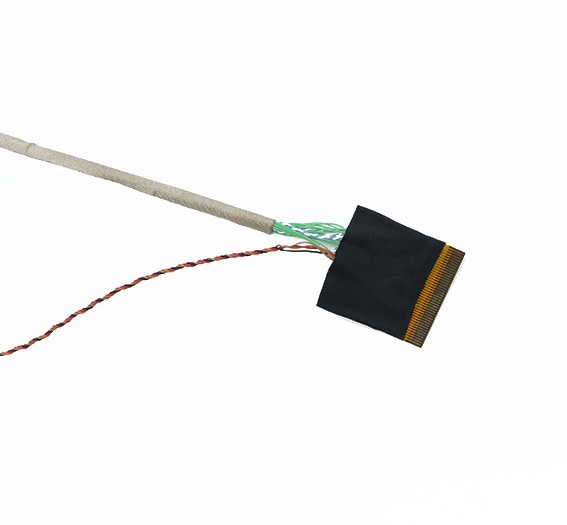
The EDP cables are mainly divided into two forms: FFC flat flexible cable and coaxial EDP shielded cable. They are responsible for transmitting high-speed differential image signals at 4K/8K. The internal wires are extremely thin and the signal pair impedance requirements are very strict. Excessive bending will cause irreversible damage in multiple dimensions such as the conductor structure, insulating medium, shielding layer, and electrical performance. Mild cases may result in screen flickering or display artifacts, while severe cases may lead to complete circuit breakage and scrap. The core reasons are disassembled layer by layer below.
1. The internal conductor is slender, and repeated / extreme bending is highly likely to cause the wire to break.
EDP is a high-speed and high-frequency transmission wire. To control the overall thickness and ensure stable differential impedance, the internal copper conductor adopts a very thin copper foil coating or ultra-fine enameled copper wire design, which is much thinner than ordinary power cables. The copper foil thickness of the conventional notebook FFC-type EDP is only 0.03-0.05mm, resulting in extremely poor rigidity; the single-channel core wire of the shielded coaxial EDP is less than 0.1mm in diameter.
When the cable is bent with a too small radius, at an angle close to 90 degrees or even folded, the inner side of the conductor is compressed and squeezed, while the outer side is stretched forcefully. If the copper material exceeds the deformation limit, micro-cracks will occur. A single excessive bend may not be noticeable to the naked eye, but the cracks will increase the line resistance; after repeated bending multiple times, the cracks will continue to expand, eventually resulting in partial short circuit or complete short circuit.
The fault of a broken wire is concealed: when there is a slight crack, the wire will only flicker the screen and lose the signal when shaken, and it can recover briefly after being left to rest, making repair very difficult to locate; after complete fracture, the screen will directly go black, and the entire EDP cable can only be replaced, and cannot be repaired.
2. Differential impedance imbalance leads to complete failure of high-speed signal transmission
The EDP core relies on a 100Ω standard differential impedance to transmit high-speed image signals. The clarity and refresh rate of the picture completely depend on the constant impedance, which is the biggest difference between it and ordinary wiring. The thickness of the cable insulation layer, the spacing of the wires, and the material of the dielectric all determine the impedance value.
Excessive bending will compress the wiring structure, and the spacing of the wires at the bending point is forced to be reduced. The insulating medium is compressed and thinned, and the local dielectric constant changes. The impedance in the bending area deviates from the standard 100Ω, resulting in a sudden impedance change point. High-speed differential signals passing through this change point will cause signal reflection, attenuation, crosstalk, loss of high-frequency data, and visually manifest as screen stripes, color blocks, screen flickering, inability to light up 4K resolution, and frame loss at high refresh rates.
LVDS low-speed cables have a high tolerance for impedance and are hardly affected by slight bending, but the single-channel bandwidth of EDP can reach several Gbps. Even a small impedance deviation will seriously interfere with the video signal. The impedance distortion caused by folding or small radius bending is almost irreversible, and the original structure cannot be restored even when the bending position is released.
3. Damage to the insulation layer leads to short circuits and leakage risks
The insulation layer of EDP is mostly made of PET and PI films, which are thin and have limited mechanical strength. During extreme bending, the surface layer and inner layer films of the wiring will rub against and squeeze each other, resulting in minor scratches and cracks on the film surface. If only the surface insulation is damaged, it will reduce the temperature resistance and insulation performance of the wire; if the insulation of adjacent differential wires both rupture, the two copper conductors will come into direct contact, forming a short circuit between the wires.
After a short circuit, the motherboard graphics card chip may overload, and the screen backlight may flicker; in severe cases, the EDP interface and driver IC may be burned, causing permanent damage to the hardware. Under high-temperature conditions, the damaged insulation layer will accelerate aging, and the damaged area will continuously expand, resulting in a significant increase in the occurrence rate of faults. For EDP with aluminum foil shielding, the aluminum foil at the bending point is prone to tearing off easily, and when the shielding layer is incomplete, the anti-interference ability will directly drop significantly.
4. Breakage of the shielding layer, intensification of electromagnetic interference
For industrial and vehicle-mounted EDP with double-layer shielding, the outer layer of aluminum foil and copper mesh net serve to isolate EMI electromagnetic interference. During excessive bending, the less ductile aluminum foil will directly break, and the weaving threads of the copper mesh net will be pulled off, resulting in large-area gaps in the shielding layer.
After the shielding is incomplete, the electromagnetic noise generated by the power supply, motor, and motherboard chip will directly couple into the differential signal line, causing continuous water waves and horizontal lines of interference on the screen. At the same time, the broken shielding metal debris is prone to fall off and scatter at the motherboard and screen interface, easily causing interface short circuits and triggering overall machine failures. Moreover, the tearing of the shielding layer is a permanent damage and cannot be restored to the shielding structure by pulling straight materials.
5. Reinforcement and Stress Concentration at Terminal Root, Accelerating Breakage
At both ends of the EDP wiring, there are reinforcing plates used for connecting the screen and the motherboard. The most dangerous area for bending is concentrated at the root of the wiring coming out of the reinforcing plate. Here, the soft and hard materials meet, and the stress is all concentrated at the junction point, which is a weak point for the wire stress.
If during daily wiring, a right-angle bend is made here and it is constantly compressed for a long time, the root copper foil will break within a short period of time. During the opening and closing of the equipment and during vibrations, the bending position continuously bears alternating stress, and the aging speed is several times that of the straight area. After using the equipment for a period of time, intermittent black screen failures occur frequently.
Summary
EDP is not an ordinary power cord. The core constraints lie in ultra-thin conductors, strict 100Ω differential impedance, and lightweight insulating shielding structure. Excessive bending will cause conductor cracks, impedance deviation, insulation damage, and shielding failure, which are four irreversible damages that directly affect the stability of image transmission and even cause hardware to burn out. The standard usage requirements state that the bending radius should be no less than 10 times the thickness of the cable, and folding in half or dead bends at right angles are prohibited. During wiring, a slack margin should be reserved to reduce the long-term force on the cable, so as to extend the service life of the EDP cable and ensure the stable operation of the display device.
Contact: Jerry_Shi
Phone: +86-13652508770
Tel: +86-13652508770
Email: [email protected]
Add: LianFeng Road,XianXi Village,ChangAn Town,DongGuan City,GuangDong Province,China