
Home > News
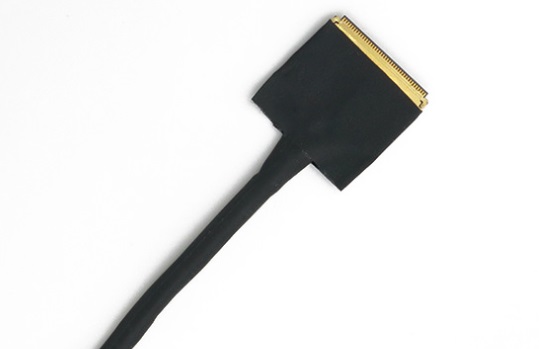
EDP (Embedded DisplayPort) cables serve as high-speed signal transmission media for laptops, industrial control displays, and automotive display devices. Their heat resistance and anti-interference capabilities are jointly determined by cable structure, insulation and shielding materials, and manufacturing design. Standard consumer-grade EDP cables only meet requirements under normal ambient temperatures, whereas industrial and automotive custom versions offer dual performance features of wide temperature tolerance and enhanced shielding. Below, we analyze these two key aspects—heat resistance and interference suppression—in detail.
1. Heat Resistance Classification and Core Limitations of EDP Cables
The maximum operating temperature of EDP cable is entirely determined by the insulation material, and there are three standard types available on the market, each suited to different application scenarios.
Standard consumer laptop FFC flexible flat cables (EDP) use PVC or regular PET as insulation materials, with a rated long-term operating temperature range of only -20°C to 80°C. However, prolonged heat from screen backlighting and motherboard chips can cause localized temperatures to exceed 90°C. Long-term exposure to high temperatures may lead to softening, delamination, and brittleness of the insulation layer, resulting in impedance mismatch in differential pairs and issues such as screen flickering, color distortion, or intermittent disconnections. Conventional PET materials begin to degrade rapidly above 100°C, leading to molecular chain breakage, significant reduction in insulation resistance, and potential short-circuit risks.
For mid-range industrial control EDP lines, modified PI and modified PET insulation are selected. The long-term temperature resistance can reach 105℃, capable of coping with the sealed high-temperature environment inside industrial computer cases. After a 250-hour high-temperature aging test, the tin-plated layer of the terminals is not prone to oxidation at high temperatures, maintaining stable contact resistance. For high-end vehicle-mounted and military special EDP, FEP fluoropolymer, PEEK, and silicone composite insulation are adopted. The long-term working temperature range covers -40℃ to 150℃, and can withstand short-term peak temperatures above 200℃. The chemical stability of fluoropolymer is extremely strong, and it does not release harmful gases or soften and deform at high temperatures. It is the preferred base material for high-temperature equipment.
The negative impact of high temperature on the performance of EDP can be divided into two aspects: Firstly, the insulation layer fails. High temperature causes the dielectric constant of the medium to change, resulting in the loss of control of the 100Ω impedance of the differential signal, and the reflection and attenuation of high-frequency signals intensify; Secondly, the metal shielding layer oxidizes. The melting point of aluminum foil shielding is only 660℃. Over a long period, at temperatures above 120℃, an insulating film of aluminum oxide is rapidly generated, and the contact resistance of the copper braided shielding increases after being oxidized at high temperatures, causing a significant decline in shielding effectiveness. The combination of these two factors will directly damage the stability of the picture. At the same time, high temperature accelerates the aging of reinforcing plates and heat shrink tubing, and the bending points of the wires are prone to cracking and breaking, shortening the service life. Therefore, in high-temperature conditions, it cannot be solely relied on thickening the insulation layer; insulation and shielding materials must be upgraded simultaneously.
II. The Underlying Principles and Structural Advantages of EDP Line Anti-interference
The native EDP protocol comes with inherent anti-interference capabilities and is equipped with a multi-layer shielding structure. Overall, its anti-interference performance is significantly superior to that of traditional LVDS cables. It consists of two layers of protection: the protocol level and the physical structure.
At the protocol level, EDP uses low-voltage differential signal transmission. Each video channel is a pair of differential lines. Interference signals will be synchronously coupled to the two wires. The receiving end directly cancels the common-mode interference through difference operation, naturally suppressing electromagnetic noise caused by motors, power supplies, and DC-DC modules. Meanwhile, the AUX auxiliary channel is independently wired, and the control signal is not affected by video crosstalk. Compared to single-ended transmission cables, the differential structure can reduce base crosstalk by more than 30%, and is suitable for high-bandwidth signal transmission such as 4K and 240Hz.
The physical shielding is structured in three levels, each level enhancing the EMI resistance capability progressively. The basic model only has a single aluminum foil total shielding, suitable for the low-interference environment inside laptops, capable of blocking external low-frequency radiation; the mid-range model adopts differential pair split aluminum foil shielding + outer layer copper braided total shielding, each group of high-speed lane is isolated separately, the crosstalk between wire pairs is controlled within -40dB, eliminating signal mutual interference, suitable for multi-screen integrated machines and small industrial control devices; the high-end industrial / vehicle EDP uses aluminum foil + high-density tin-coated copper mesh double-layer shielding, the weaving coverage rate is ≥85%, the tin-coated copper layer is resistant to high temperatures and oxidation, taking into account both high-frequency and low-frequency full-band shielding, after 360° complete grounding, the shielding effectiveness can reach above 70dB, capable of resisting strong electromagnetic radiation from frequency converters and large current wiring. Ordinary unshielded EDP flexible cable can only be used for thin and light laptops without high-power components, and is prone to horizontal stripes and screen jitter when close to power supplies and driver chips; while the double-layer shielded EDP can work stably in complex electromagnetic environments such as industrial control cabinets and vehicle central control consoles. At the same time, the grounding process of the shielding layer is crucial, the connection points must be fully ring-shaped and pressed, and the shielding break point will cause the shielding effectiveness to be zero, resulting in intermittent screen flickering faults.
III. Key Points for Selecting Components with High Temperature Resistance and Anti-Interference Capabilities
The two performances have a material synergy relationship. Ordinary PVC insulation combined with aluminum foil shielding can only be used at normal temperatures; in high-temperature environments, fluoropolymer insulation combined with tin-plated copper braided shielding is required, and aluminum foil shielding is not suitable for long-term high-temperature conditions. In daily consumer electronics with an environment of 80°C or below, ordinary PET single-layer shielded EDP can meet the requirements; for industrial control enclosures with a temperature range of 90-105°C, modified PI double-layer shielded EDP is selected; for vehicle and military high-temperature and high-interference scenarios, FEP insulation + fully wrapped copper mesh shielding special EDP must be used.
Overall, EDP is not inherently resistant to high temperatures and has strong anti-interference capabilities. Its performance entirely depends on the materials and processes used. Standard consumer-grade products only meet the requirements of normal temperature and low-interference environments. For high-temperature and strong electromagnetic scenarios, custom upgrades to insulation and shielding structures are required to simultaneously achieve stable heat resistance and reliable anti-interference, avoiding abnormal images and premature aging and failure of cables.
Contact: Jerry_Shi
Phone: +86-13652508770
Tel: +86-13652508770
Email: [email protected]
Add: LianFeng Road,XianXi Village,ChangAn Town,DongGuan City,GuangDong Province,China