
Home > News
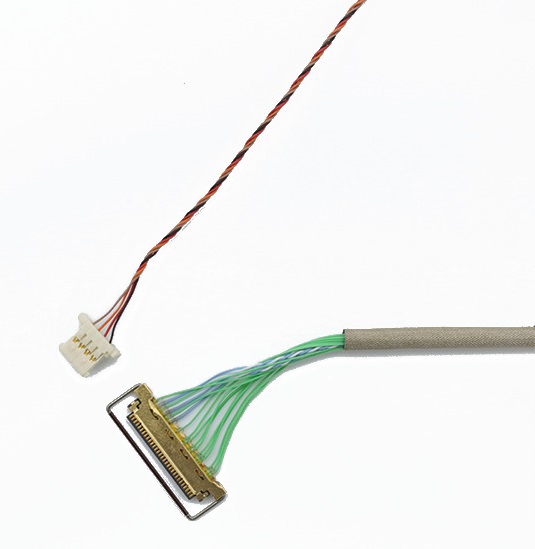
EDP (Embedded DisplayPort) is the built-in display cable used in laptops and industrial control panels. The mainstream specifications are divided into three types: 30-pin, 40-pin, and 50-pin. Native EDP cables with different pin counts cannot be directly shared; limited compatibility can only be achieved through dedicated adapter cables, which come with numerous hardware constraints and potential risks. Below, we provide a comprehensive breakdown of physical structure, electrical definitions, bandwidth functionality, failure hazards, and special adaptation scenarios.
From a physical structure standpoint, EDP cable with different pin counts cannot be directly connected due to inherent incompatibility, and there is no universal standard. The industry predominantly uses 0.5mm pitch for EDP connectors, but the total number of pins determines the overall interface width: 30-pin interfaces are narrower, while 40-pin and 50-pin interfaces are longer. As a result, plug dimensions and latching mechanisms do not match at all—forcefully inserting or removing them can bend the gold fingers on both the motherboard and screen sides, causing permanent damage to the interface. Even when some cables appear to have the same pitch, differences in pin arrangement reference points and latch positions vary by manufacturer, making it impossible for a 30-pin plug to fit into a 40-pin socket, thus eliminating any possibility of compatibility at the physical level. Some technicians mistakenly attempt to modify cables with identical pitch but differing pin counts, which often leads to misaligned pins, short circuits, and ultimately damages the screen backlight driver and graphics output module.
The difference in electrical pin definitions is the core reason for the inability to be shared. The EDP pins include high-speed differential data channels, AUX auxiliary communication, HPD hot-swapping detection, 3.3V power supply, backlight control, and six types of ground signals. The more pins, the more reserved function pins. Most 30-pin models have 2-channel EDP, equipped with only two sets of high-speed differential pairs, suitable for low-load screens with a resolution of 1080P and a refresh rate of 60Hz or less, and retain only basic power supply, backlight, and communication pins. The 40-pin model has 4-channel standard EDP, with two additional sets of high-speed differential channels, and extra multi-ground, redundant power supply, and touch signal pins, capable of supporting 2K/4K, 120Hz high-refresh-rate screens. The 50-pin model is mostly used for high-end gaming laptops and industrial touch screens, with additional touch power supply and multi-zone backlight control pins. The mapping logic of the two types of cable pins is completely independent. The 30-pin cable lacks the required high-speed data channels of the 40-pin model, and the 40-pin cable has extra pins without corresponding signal definitions, and direct replacement will result in black screen, no backlight, screen flickering, and touch failure, etc.
There is a fundamental gap between bandwidth and functional carrying capacity. Mixing them will directly lead to restricted display specifications. The total bandwidth of 30Pin 2Lane EDP only meets the basic output of 1080P and cannot drive resolutions of 2K and above; the bandwidth of 40Pin 4Lane is doubled, which is the necessary hardware foundation for high-resolution and high-refresh-rate screens. If the 30Pin wiring is replaced with the original 40Pin wiring, even if the physical connection of the screen is completed, the output bandwidth of the graphics card is insufficient, and the picture will have tearing, color block missing, and the refresh rate will lock at 60Hz; conversely, using 40Pin wiring to connect a 30Pin screen, the extra channels have no receiving end, the motherboard cannot recognize the EDID screen information, and continuously determines that there is no display output. At the same time, the 40Pin comes with dedicated touch pins, while the 30Pin has no corresponding lines. After replacing the touch wiring of the touch screen device with 30Pin wiring, the touch function will directly fail. Industrial equipment will also lose expansion signals such as temperature control and brightness adjustment.
Forcibly mixing incompatible hardware poses the risk of irreversible damage. Misalignment of pins can cause short circuits between the 3.3V power supply pin and the ground, as well as between the high-speed differential channels, resulting in instantaneous breakdown of the screen driver IC and the motherboard display chip. The absence of the ground pin can cause high-speed signal interference, leading to continuous flickering and picture noise. Long-term high-voltage interference accelerates the aging of the wire insulation layer; mismatch in the backlight control pin definition can cause the backlight to remain constantly on, inability to adjust, and instantaneous overcurrent, resulting in burning of the backlight strip. A large number of cases in the repair industry show that without conversion and direct mixing of EDP cables with different pin counts, over 60% result in screen damage, motherboard graphics card interface damage, and the repair cost is much higher than the cost of the wire itself.
The only limited compatibility solution is a dedicated EDP pin number conversion cable, but it is not truly universal. The 30-to-40 and 40-to-30 conversion cables internally re-map differential channels, power supply and control signals, and are only applicable to low-load screens with the same resolution and channel count. They cannot break through the hardware bandwidth limit, and 4K high-refresh-rate screens cannot be downgraded and adapted through the conversion cables. The conversion cables are passive adapter devices, which will increase signal attenuation. Long-distance use is prone to unstable transmission, and they are only compatible with the universal standard pin definitions. Apple, Lenovo, and Dell custom pin screens still cannot be compatible and can only be used as temporary repair alternatives. They cannot be used for long-term mass production.
In conclusion, the native EDP cables with different pin numbers do not have the conditions for sharing. The three barriers of physical interface, electrical definition, and bandwidth specification cannot be broken through. Daily maintenance and screen upgrades must strictly match the original factory cables with the same pin number, same channel, and same pin definitions; if cross-pin number adaptation is needed, only the corresponding specification dedicated conversion cables can be selected, and the screen resolution, refresh rate, and touch function must be confirmed to be compatible in advance to avoid direct replacement and mixed use, which can prevent permanent hardware damage.
Contact: Jerry_Shi
Phone: +86-13652508770
Tel: +86-13652508770
Email: [email protected]
Add: LianFeng Road,XianXi Village,ChangAn Town,DongGuan City,GuangDong Province,China