
Home > News
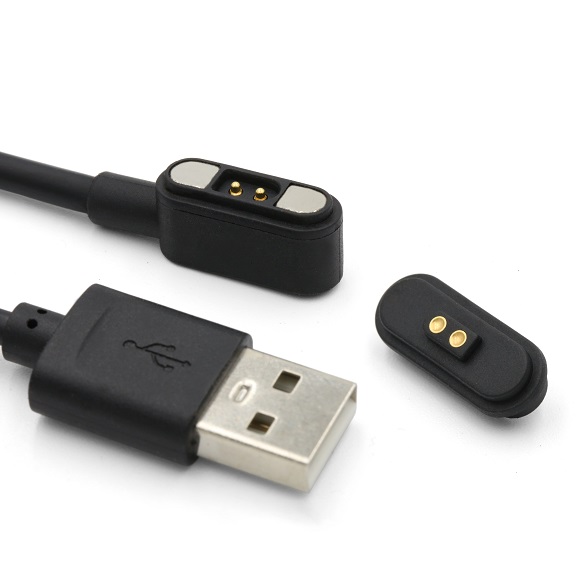
The core difference between magnetic charging cables and non-magnetic cables (traditional data cables) lies in their connection method: the former uses magnetic attraction for coupling, while the latter relies on physical plug-and-unplug connections. This fundamental distinction leads to significant differences across multiple dimensions, including convenience, durability, performance, compatibility, and price. Below is a detailed explanation from six key aspects.
Magnetic Wire: Composed of a magnetic head at the cable end and a magnetic connector at the device end (which needs to be pre-embedded in the device interface), it automatically adheres when close, supports 360° blind insertion, and is effortless to operate even with one hand. It will automatically detach in case of accidental pulling, preventing the device from being pulled off and damaged. It offers excellent experience in car-mounted and bedside scenarios. Some full-body magnetic wire designs can automatically fold and not tangle, making the desktop and bag interior more tidy.
Non-magnetic Wire: Dependent on physical insertion and removal, it requires precise alignment with the interface. Blind insertion is difficult, and frequent insertion and removal can cause hand strain. When pulled, the force is directly transmitted to the device interface, which may cause the interface to loosen or the device to fall; the wire is prone to tangle and knot, and the storage process is time-consuming.
Magnetic Charging Cable: The mainstream models support fast charging protocols such as PD, QC, and Huawei SCP. The high-end models can reach a power of 240W. However, the magnetic contact points have contact resistance, which leads to a power loss of 5% to 10%. The wattage of 100W fast charging might drop to around 90W. In terms of data transmission, the mid-to-high-end magnetic charging cables can meet daily file transfer needs, but some low-priced models only support charging and do not support data synchronization.
Non-magnetic Charging Cable: The performance is stable with no power loss. Original or high-quality cables can fully support the fast charging power. The temperature control performance is solid. The data transmission speed is guaranteed. USB 3.0 and above specifications can meet the requirements for high-definition video and large file high-speed transmission, without transmission delay or connection interruption issues.
Magnetic cable: Requires an exclusive magnetic connector. Although it can be adapted to different interfaces such as Type-C and Lightning by replacing the connector, the magnetic standards of different brands are not unified, resulting in interoperability issues. Some cables cannot be matched with specific devices. Moreover, when the magnetic connector is embedded in the interface, it will affect the waterproof and dustproof performance of the device.
Non-magnetic cable: Uses industry-standard interfaces. Type-C, Lightning, Micro-USB, etc. interfaces are globally unified and compatible with all corresponding interface devices. No additional accessories are required, and it is plug-and-play, with no compatibility shortcomings.
Magnetic charging cable: The price is relatively high. The basic model costs 10 to 30 US dollars. The mid-to-high-end model with fast charging support costs 40 to 80 US dollars. The certified Apple model exceeds 100 US dollars and requires an additional purchase of the magnetic connector (6 to 10 US dollars per piece). In the long run, due to its long lifespan and fewer interface maintenance needs, it offers better cost-effectiveness in high-frequency usage scenarios.
Non-magnetic charging cable: The price is affordable. The ordinary model costs 6 to 12 US dollars. The high-quality woven model costs 10 to 20 US dollars. It has outstanding cost performance and the replacement cost is extremely low after damage. However, the long-term cost of frequent replacements may be higher than a high-quality magnetic charging cable.
Magnetic connection cable: Suitable for high-frequency plugging and unplugging (such as at the bedside, on the office desk), vehicle charging, multi-device users (compatible with multiple devices in one device), elderly/children use (simple operation) and other scenarios.
Non-magnetic connection cable: Suitable for limited budget, single-device low-frequency use, high-speed data transmission requirements, and those who pursue ultimate stability (such as professional equipment charging) and other scenarios.
Overall, magnetic connection cables are superior in terms of convenience, protection of interfaces, and ease of storage. Non-magnetic cables, on the other hand, are better in terms of stability, compatibility, and low price. When choosing, for high-frequency multi-device use, magnetic connection cables are recommended; for low-frequency single-device use or when emphasizing data transmission, non-magnetic cables should be selected.
Contact: Jerry_Shi
Phone: +86-13652508770
Tel: +86-13652508770
Email: [email protected]
Add: LianFeng Road,XianXi Village,ChangAn Town,DongGuan City,GuangDong Province,China