What are the disadvantages of LVDS cable?
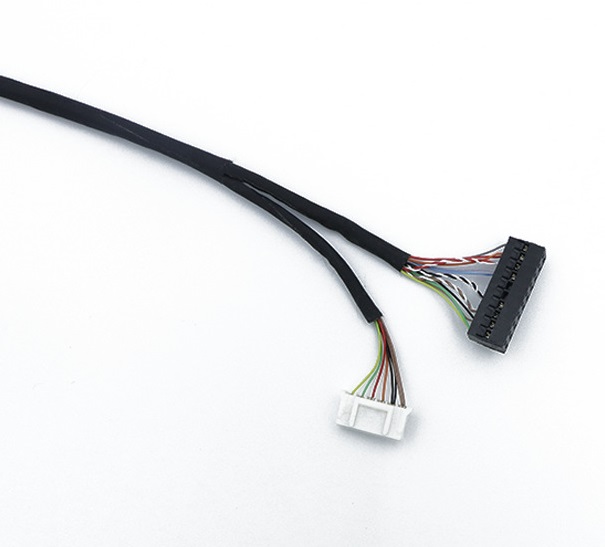
LVDS (Low Voltage Differential Signaling) cables are widely recognized for their high stability, strong anti-interference ability and low power consumption, making them a mainstream transmission medium for internal display connections in notebooks, industrial equipment and automotive electronic systems. While LVDS cable excel in embedded and industrial scenarios with their unique technical advantages, they also have obvious and unavoidable disadvantages in interface compatibility, resolution limits, installation flexibility and universal applicability. Understanding the shortcomings of LVDS cables is essential for electronic designers and users to select the most appropriate transmission solution and avoid equipment failures and usage limitations caused by improper cable selection.
The most prominent disadvantage of LVDS cables is poor universal compatibility and non-standard interface design. Unlike HDMI, USB and other consumer cables with unified global interface specifications, LVDS has no fixed universal interface standard. Most LVDS cables are customized according to the internal circuit structure of specific equipment, with different pin definitions, wire sequences and interface sizes among different manufacturers and device models. This means an LVDS cable suitable for a laptop screen cannot be adapted to industrial displays or vehicle-mounted screens. Once the cable is damaged, users cannot replace it with a universal spare part and have to purchase a model-specific customized cable, which increases maintenance difficulty and replacement costs greatly. Such poor compatibility makes LVDS cables completely unsuitable for cross-device and cross-brand universal connection scenarios.
Secondly, LVDS cables face inherent limitations in ultra-high-definition resolution and high-frame-rate transmission. Restricted by its traditional differential signal transmission mechanism, the bandwidth of classic LVDS technology is relatively fixed and cannot keep up with the rapid upgrading of modern display technology. Traditional single-channel and dual-channel LVDS can only stably support 1080P and below resolution displays. When facing 4K, 8K ultra-high-definition screens and high-refresh-rate gaming displays, LVDS cables are prone to insufficient bandwidth, resulting in screen flickering, color distortion, frame dropping and incomplete image display. Compared with the latest HDMI and DP cables that support ultra-high resolution and high dynamic range imaging, LVDS cables lag far behind in multimedia performance, gradually failing to meet the demand of high-end high-definition display equipment.
Complex wiring requirements and low installation flexibility are another major drawback of LVDS cables. Different from ordinary single-wire multimedia cables, LVDS transmission relies on multiple pairs of twisted differential signal lines, plus independent power lines and grounding lines. A complete LVDS cable harness contains multiple groups of fine wire cores, requiring strict wiring sequence and spacing standards during installation. Workers must strictly follow professional wiring specifications to avoid signal crosstalk and short circuits. Moreover, LVDS cables have strict restrictions on bending angle and twisting range. Excessive bending or extrusion will damage the internal twisted-pair structure, destroy impedance matching and directly lead to signal failure. Its complicated installation process raises the threshold for equipment assembly and daily maintenance.
In addition, LVDS cables lack audio transmission and extended intelligent functions. LVDS technology is purely designed for low-speed and medium-speed image signal transmission, focusing only on the stability of video data. It cannot realize synchronous integrated transmission of audio signals, which is far less practical than HDMI cables that transmit video, audio and device control signals through a single cable. In multimedia intelligent equipment, using LVDS requires additional independent audio lines to match sound output, increasing the complexity of internal circuit layout. Meanwhile, LVDS does not support intelligent functions such as signal encryption, device identification and one-key switching of display modes, which cannot adapt to the intelligent interaction needs of modern consumer electronic devices.
Finally, LVDS cables have limited transmission distance and high aging failure rate in long-term use. Although LVDS can transmit signals for several meters, its signal stability will drop sharply with the increase of distance. Excessively long wiring will cause signal attenuation and synchronization errors. Furthermore, the internal fine twisted-pair structure of LVDS cables is fragile. Under long-term vibration, high temperature and frequent bending, the wire cores are easy to age and break, and the shielding layer is prone to wear. Compared with durable universal cables, LVDS cables have a shorter service life and higher failure rate in complex working environments.
To sum up, despite the stable anti-interference performance of LVDS cables, their defects in poor compatibility, limited resolution bandwidth, complicated installation, single function and easy aging restrict their application scope. They can only be used for fixed internal display connection of equipment and cannot adapt to universal multimedia connection and high-end ultra-high-definition display scenarios. Only by avoiding their shortcomings and making targeted selection can we maximize the application value of LVDS transmission technology.