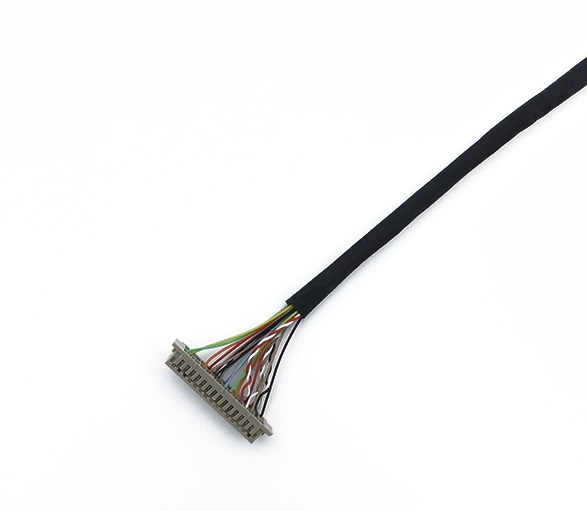
Low Voltage Differential Signaling (LVDS) cables are foundational components for high-speed data transmission in modern electronic devices, widely used in display screens, industrial control systems, automotive infotainment equipment, and medical instruments. Known for their low power consumption, strong anti-interference ability, and high transmission efficiency, LVDS cables ensure stable signal transmission between display panels and main control boards. However, due to improper installation, harsh operating environments, aging wear, and mismatched configurations, LVDS cables frequently encounter various faults. These problems directly lead to abnormal display effects, system instability, and even equipment downtime. Understanding common
LVDS cable problems, their root causes, and corresponding solutions is critical for equipment maintenance and long-term stable operation. This article analyzes the most prevalent LVDS cable issues in practical applications.
Signal interference and signal integrity degradation are the most common and influential problems of LVDS cables. LVDS transmits data through differential signal pairs, which relies on balanced signal transmission to resist external noise. Once the balance is broken or shielding fails, electromagnetic interference (EMI) occurs, damaging signal quality. The typical manifestations include screen flickering, random snowflake spots, horizontal or vertical colored lines, and blurred display images. In industrial scenarios, LVDS cables are often arranged near power lines, motors, and transformers, whose high-frequency electromagnetic radiation interferes with weak differential signals of LVDS cables. Besides, poor shielding design is a major internal cause. Many low-cost LVDS cables only adopt single-layer aluminum foil shielding without braided copper layers, failing to block high-intensity electromagnetic noise effectively. Loose shielding layers and incomplete 360-degree grounding at connectors also cause signal leakage and interference. In addition, excessive cable length and irregular wiring such as excessive bending and crossing with power cables will increase signal attenuation and crosstalk between differential pairs, further deteriorating signal integrity.
Physical damage and mechanical failure are frequent faults in daily use, especially for devices with frequent movement or vibration. LVDS cables, especially flexible ribbon cables, have strict requirements on bending radius and tensile force. Frequent bending, excessive stretching, or violent extrusion will lead to internal wire breakage and insulation layer cracking. Different from complete cable breakage, partial wire breakage causes intermittent signal transmission, resulting in occasional screen blackouts and flickering, which are difficult to troubleshoot. Connector damage is another typical mechanical problem. Mismatched plugging and unplugging, such as forcing 30-pin cables into 40-pin interfaces, often causes bent, broken, or oxidized pins. Statistical data from maintenance laboratories shows that most motherboard and display panel damage is indirectly caused by damaged LVDS cable pins. Moreover, long-term vibration of automotive and industrial equipment will loosen cable interfaces, leading to poor contact and unstable signal transmission. Insulation sheath aging and cracking are also common physical faults, which may cause short circuits between signal pins and burn out display control chips in severe cases.
Configuration mismatch and compatibility failures are easily overlooked LVDS cable problems, usually occurring during equipment replacement and cable upgrading. Many users ignore the parameter consistency of LVDS cables and blindly replace old cables with generic third-party products, triggering compatibility issues. First, impedance mismatch seriously affects transmission stability. LVDS cables have fixed characteristic impedance standards; cables with unqualified impedance will cause signal reflection and distortion, resulting in abnormal display. Second, pin definition differences lead to functional failures. Different brands of display panels and motherboards have distinct LVDS pin sequences, and wrong pin connections will cause black screens, color cast, or even circuit short circuits. In addition, some advanced display systems require cables with built-in EEPROM chips to store vendor identification and configuration information. Generic cables without corresponding identification data cannot complete system handshake, leading to the system failing to recognize the display device despite normal hardware connection. Length mismatch is also a common problem: overly long cables increase signal delay and attenuation, while overly short cables cause interface tension and poor contact.
Environmental aging and performance degradation are long-term latent problems that affect the service life of LVDS cables. Electronic equipment often operates in complex environments: high temperature accelerates the aging of cable insulation materials, softens and deforms the sheath, and reduces insulation performance; low temperature makes the cable material brittle, easy to crack during slight bending. Humid and dusty environments cause metal pins and shielding layers to oxidize and rust, increasing contact resistance and weakening signal transmission capability. In industrial and automotive scenarios, oil pollution and chemical corrosion will erode the cable sheath, damaging internal wire cores and shielding structures. Long-term continuous operation will also lead to fatigue aging of cable internal materials, gradually reducing anti-interference performance and transmission stability, resulting in slowly worsening display faults that are difficult to detect in the early stage.
In conclusion, common LVDS cable problems mainly cover signal interference, mechanical damage, compatibility mismatch, and environmental aging, most of which are preventable through standardized selection, installation, and maintenance. To ensure the stable operation of LVDS transmission systems, users should select high-quality shielded cables that meet equipment parameters, standardize wiring and installation processes, avoid excessive bending and interface mismatch, and conduct regular inspection and maintenance of cables and connectors. Timely elimination of potential cable faults can effectively reduce equipment failure rates and extend the service life of display and control systems.