How long can an LVDS cable be?
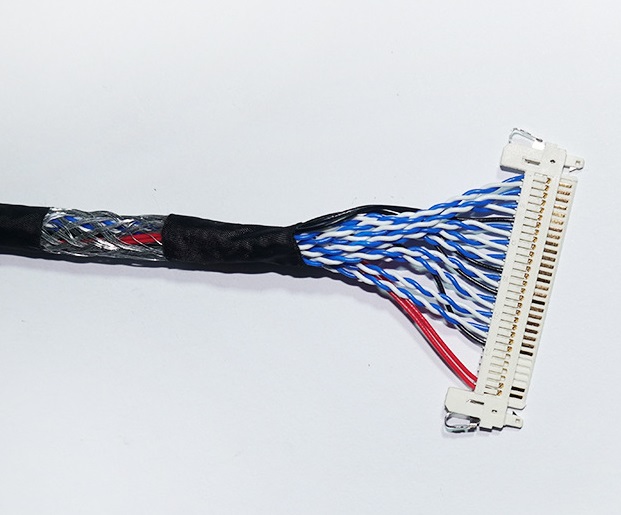
LVDS (Low Voltage Differential Signaling) cables are widely adopted for high-speed, low-noise data transmission in display devices, industrial machinery, automotive systems, and consumer electronics. A critical question for installation and equipment design is the maximum usable length of an LVDS cable. Unlike ordinary wires, LVDS cable length is not unlimited. It is strictly restricted by transmission rate, signal integrity, cable quality, working environment, and shielding conditions. Excessively long cables will cause signal attenuation, crosstalk, and delay errors, leading to screen flickering, color distortion, or total display failure. Understanding the effective length range and influencing factors of LVDS cables is essential for stable system design and equipment installation.
In general industrial and commercial standards, the conventional effective length of ordinary LVDS cables ranges from 0.5 meters to 5 meters under normal working conditions. For standard low-speed LVDS transmission with a data rate below 1Gbps, high-quality shielded cables can reach a maximum length of 8 meters in stable environments. However, for high-speed LVDS applications with transmission rates up to 2Gbps or higher, the safe length is usually limited within 3 meters. This length limitation mainly stems from the working principle of differential signal transmission. As cable length increases, signal loss accumulates continuously, and the time difference between differential pairs rises, destroying signal balance and triggering data transmission errors.
Cable quality and structural design are the most decisive factors affecting maximum length. High-grade LVDS cables adopt double-layer shielding, twisted differential pairs, and precise impedance control at 100Ω, which effectively suppress signal attenuation and electromagnetic crosstalk. Such cables can maintain stable transmission at longer distances. In contrast, low-cost unshielded or single-layer shielding cables suffer severe signal loss. Their maximum stable length is often less than 2 meters, even at low transmission speeds. Meanwhile, cable flexibility and wire thickness also matter. Thicker core wires reduce resistance loss, allowing for longer transmission distances, while ultra-thin flexible flat LVDS cables are only suitable for short-distance internal equipment connection due to high signal attenuation.
Transmission speed and environmental interference further narrow the usable length range. LVDS length and transmission rate follow an inverse relationship: the higher the frequency, the shorter the maximum cable length. High-frequency signals are more susceptible to electromagnetic interference from power lines, motors, and high-voltage equipment. In harsh industrial environments with strong electromagnetic noise, even qualified cables need to be shortened by 30% to 50% to guarantee signal stability. In addition, irregular wiring such as repeated bending, winding, and crossing with power cables will amplify signal loss, virtually reducing the effective transmission length of LVDS cables.
For special long-distance transmission demands beyond 8 meters, passive LVDS cables cannot work stably. In this case, designers need to adopt active solutions, such as adding LVDS repeaters, signal amplifiers, or switching to optical fiber transmission modules. These devices regenerate and compensate for attenuated signals, extending the transmission distance to tens of meters while maintaining signal integrity.
To sum up, the safe length of ordinary passive LVDS cables is 0.5 to 5 meters for most scenarios, with an extreme stable length of 8 meters for low-speed and high-quality shielded models. Engineers and installers must match cable length with transmission speed, cable grade, and working environment. Reasonable length selection and standardized wiring can avoid signal failure and ensure the long-term stable operation of LVDS display and transmission systems.