What are the different types of LVDS cable?
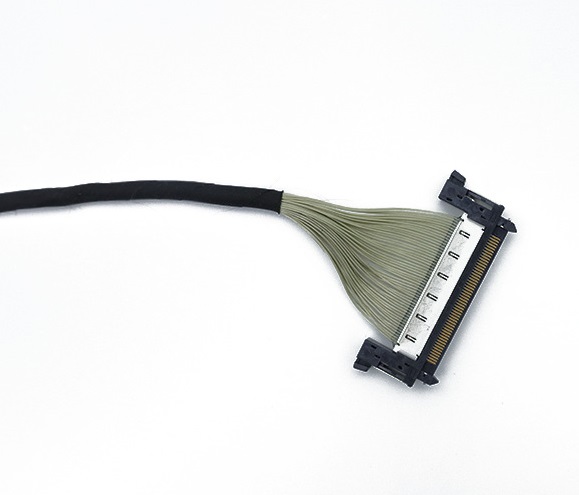
LVDS (Low Voltage Differential Signaling) cables are essential for high-speed, low-noise data transmission in displays, automotive electronics, industrial controllers, and smart devices. There is no one-size-fits-all LVDS cable. According to structural design, shielding performance, wire arrangement, and application scenarios, LVDS cables are divided into multiple types, each with unique advantages and applicable working conditions. Classifying and selecting the correct LVDS cable type is critical to ensuring signal integrity, avoiding transmission errors, and improving equipment stability. Understanding the core differences between various LVDS cables helps engineers and maintenance personnel make reasonable configurations for different devices.
The most common classification method is based on cable structure, which divides LVDS cables into flexible flat cables and twisted pair cables. Flexible Flat LVDS Cables, also known as FFC LVDS cables, feature flat, parallel wire arrangements with thin and lightweight bodies. They are highly flexible, support repeated bending, and occupy minimal installation space. These characteristics make them ideal for narrow internal spaces of liquid crystal displays, laptops, and embedded devices. However, due to the parallel wire design, flat LVDS cables have relatively weak anti-interference ability and are only suitable for short-distance transmission within 2 meters and low electromagnetic interference environments. They are the most widely used type in consumer electronic products due to their low cost and compact structure.
Twisted pair LVDS cables are another mainstream structural type, designed for high-stability and long-distance transmission. Different from flat cables, their internal differential signal lines are tightly twisted in pairs. The twisted structure effectively offsets internal crosstalk and enhances the balance of differential signals, greatly improving anti-interference performance. Most industrial and automotive LVDS cables adopt this design. Although they are slightly larger in size and less flexible than flat cables, they support longer transmission distances and higher transmission rates. They can work stably in complex electromagnetic environments and are suitable for industrial control screens, vehicle-mounted display systems, and high-precision medical equipment.
Based on shielding performance, LVDS cables can be categorized into unshielded, single-layer shielded, and double-layer shielded types. Unshielded LVDS cables have no protective shielding structure, featuring low cost but poor anti-interference capability. They are only applicable to closed internal equipment environments with no electromagnetic noise. Single-layer shielded cables usually use aluminum foil wrapping to block external interference, meeting the basic needs of most commercial devices. Double-layer shielded cables combine aluminum foil and braided copper mesh, achieving 360-degree full shielding. This type effectively resists strong electromagnetic interference from motors and high-voltage circuits, making it the preferred choice for industrial and outdoor high-speed transmission scenarios.
In addition, LVDS cables are classified by functional specifications into standard single-channel and high-definition multi-channel types. Single-channel LVDS cables are used for ordinary resolution display screens with low data volume transmission. Multi-channel LVDS cables with more wire cores support ultra-high resolution and high refresh rate displays, which are widely used in smart TVs, industrial large screens, and high-end vehicle display systems.
In summary, different types of LVDS cables are designed to adapt to diverse transmission needs and working environments. Flat cables suit compact and low-interference scenarios, while twisted-pair and double-layer shielded cables focus on high stability and strong anti-interference performance. Reasonable selection of LVDS cable types based on equipment usage scenarios can significantly optimize signal transmission quality and extend the service life of electronic equipment.