
Home > News
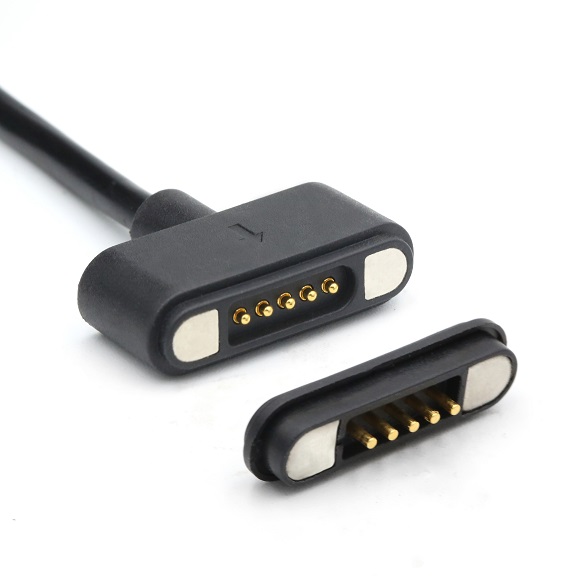
Thanks to its features of being plug-free, shock-proof, and compatible with multiple devices, the magnetic charging cable has become a common accessory for many digital users. However, many people have noticed that when using magnetic cables, problems such as poor mobile phone signal, intermittent charging, disconnection of headphones, and data transmission failure often occur. Some sophisticated digital accessories even experience malfunction. In fact, the magnetic cable is not a perfect accessory. Its inherent magnetic field characteristics, structural design flaws, and electromagnetic issues are the core reasons that interfere with digital devices and affect the normal use of accessories.
The constant magnetic field interference generated by magnetic attachment cables is the primary factor affecting precision digital devices. Magnetic attachment cables achieve adhesion and connection through built-in neodymium iron boron magnets, which have strong magnetic force and continuously produce a stable magnetic field. Modern digital devices are equipped with a large number of precise sensing components inside, such as the geomagnetic sensors in mobile phones, gyroscopes, wireless charging coils, micro sensing modules in Bluetooth headphones and smart watches, all of which are highly sensitive to the magnetic field environment. Official original magnetic attachment products precisely control the magnetic field strength and distribution, with extremely small magnetic field gradient deviation, and will not affect the operation of the devices. However, most of the affordable magnetic attachment cables on the market have irregular pole arrangements and chaotic magnetic field distribution, and the excess stray magnetic fields will directly interfere with the operation of the device sensors, causing the compass of the mobile phone to deviate, inaccurate positioning, malfunction of the touch control of smart wearable devices, and abnormal sensing and recognition.
The next issue is electromagnetic radiation and signal crosstalk, which directly disrupt the stability of signal transmission in equipment. Magnetic suction cables are electronic accessories that operate with electricity. When powered on, their magnets and metal contacts form irregular current circuits, generating additional electromagnetic radiation. Ordinary data cables have a complete shielding layer, which can effectively isolate electromagnetic interference. However, most magnetic suction cables have simplified or even no shielding design. This electromagnetic radiation can cause crosstalk with the device's Bluetooth, WiFi, and cellular signals. During daily use, this manifests as issues such as lagging sound in Bluetooth headphones, soaring network latency in gaming devices, and disconnection of mobile phone WiFi. Additionally, the chaotic electromagnetic signals can interfere with data transmission waveforms, resulting in data transmission interruptions and data corruption. It also prevents the rapid transmission of high-definition photos and videos.
The abnormal contact caused by structural design flaws further aggravates equipment and accessory failures. The magnetic suction cable relies on metal contacts to conduct current and signals. Compared to the integrated ordinary data cable, it has an additional set of external contact points. After long-term use, the contacts are prone to accumulating dust, iron filings, or experiencing slight displacement, oxidation and wear, resulting in poor contact and unstable resistance. This can cause significant fluctuations in charging voltage and current, not only causing the device to frequently start and stop charging and fail to activate the fast charging protocol, but also damaging the battery lifespan. In severe cases, the impurities on the contacts may even cause a minor short circuit, triggering the device's safety protection mechanism, leading to the failure of the accessory to power on and lose functionality, and even damaging the charging interface, charging head, and external digital accessories.
Furthermore, magnetic field compatibility conflicts can affect the coordinated use of various magnetic accessories. Nowadays, most digital devices support wireless magnetic accessories, such as phone MagSafe magnetic cases, magnetic charging batteries, magnetic stands, etc. The magnetic field strength and magnetic pole arrangement of third-party magnetic cables do not conform to the official standards. When used together, they may cause magnetic field superposition and mutual cancellation, resulting in unstable magnetic attachment, automatic detachment, and inability to function properly. Long-term exposure to disordered magnetic fields can affect the coupling accuracy of the built-in wireless charging coils in the devices, leading to permanent usage issues such as slower wireless charging and recognition failures.
In summary, the interference problem of the magnetic connection cable is essentially a conflict between strong stray magnetic fields, unshielded electromagnetic radiation, structural contact defects, and the working principle of precision digital devices. During daily use, it is recommended to preferentially choose magnetic connection cables that are properly shielded and compatible with the official magnetic field standards. Avoid using them in combination with precision digital accessories for a long time. When not in use, keep them away from electronic devices as soon as possible to minimize the risk of interference and ensure the normal operation of digital devices and accessories.
Contact: Jerry_Shi
Phone: +86-13652508770
Tel: +86-13652508770
Email: [email protected]
Add: LianFeng Road,XianXi Village,ChangAn Town,DongGuan City,GuangDong Province,China