
Home > News
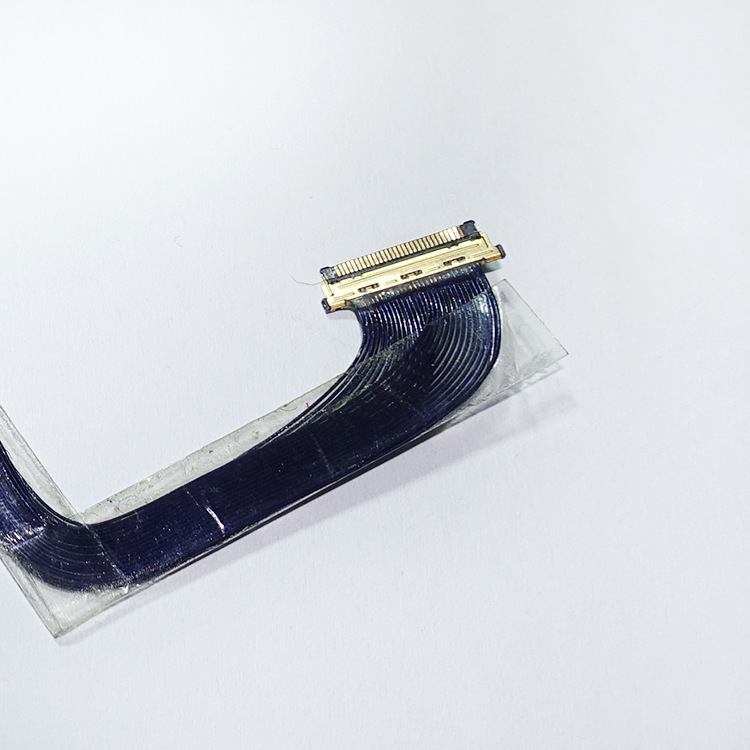
LVDS is a low-voltage differential signal transmission cable. With its core advantages of low-voltage differential transmission, strong anti-interference ability, low power consumption, and high speed, it has become the core connection cable in the traditional LCD display era. It is widely used in consumer electronics, industrial equipment, vehicle displays, medical instruments, security equipment, and other fields. Although the EDP interface is gradually replacing the LVDS on notebook computers, large-screen, industrial control, and vehicle display fields still retain a large number of LVDS lines. It is an indispensable basic cable for display transmission.
Consumer notebooks and desktop monitors were the earliest application scenarios for LVDS cables. In the interiors of early 14-inch to 17-inch laptops, LVDS screen cables were used to connect the motherboard and the LCD screens. The mainstream specifications were 30PIN and 40PIN. The 30PIN type was suitable for 1366×768 low-resolution screens, while the 40PIN dual-channel 8-bit cable could carry 1080P full HD images. Due to the limited space inside the laptop and the battery power supply constraints, the low-voltage and low-electromagnetic-radiation characteristics of LVDS were perfectly adapted to the notebook environment, avoiding high-speed signal interference with the battery, sound card, and wireless modules. In the interiors of desktop LCD monitors, the driver board and the LCD panel also relied on LVDS cable to transmit image signals. 20PIN and 50PIN cables were common. Small-sized 19-inch or smaller displays mostly used 30PIN single-channel LVDS, while 27-inch early large-screen TVs adopted 51PIN dual-channel cables. At the same time, the cables integrated backlight control and screen power supply pins, simplifying the internal wiring and reducing the overall production cost. During the golden stage of LCD popularity in home use, long-distance LVDS cables were used between the logic board and the screen for 32-inch to 65-inch models. The internal power supply and amplifier circuits of the TV had severe electromagnetic interference. The differential transmission structure could effectively cancel out noise, ensuring no horizontal lines or flickering on the screen.
The industrial automation field is the core sector where LVDS cables have been consistently used to date. All kinds of industrial control touch screens, embedded industrial all-in-one machines, machine tool operation displays, and equipment operation panels are all equipped with LVDS cables. Industrial workshops have frequency converters, motors, high-voltage distribution cabinets, and extremely harsh electromagnetic environments. Ordinary single-ended signal lines are prone to image distortion easily. With positive and negative differences divided into pairs for transmission, LVDS has an anti-interference capability far superior to ordinary parallel cables. Small 7-inch and 10-inch industrial screens mostly adopt 20PIN short LVDS cable assemblies, which are installed on the operation ends of CNC lathes and injection molding machines. 15-inch and 19-inch industrial touch control all-in-one machines use 40PIN dual-channel LVDS, supporting long-term 7×24-hour uninterrupted operation. In addition, in the internal parts of detection instruments, PLC companion display terminals, charging station human-machine interaction screens, self-service ticket vending machines, and self-service cash registers, all rely on LVDS to transmit images. Industrial-specific LVDS cables are equipped with shielding aluminum foil and reinforced connectors, which are resistant to bending, high and low temperatures, and suitable for complex environments such as factory buildings and outdoor cabinets.
The vehicle-mounted display equipment has strict requirements for the stability of the wiring. LVDS wiring is the mainstream transmission solution for vehicle screens. Large central control screens, instrument LCD dashboards, rear entertainment displays, and rearview camera displays in cars are all equipped with LVDS lines. During vehicle operation, the engine and on-board inverter will generate continuous electromagnetic interference, and the temperature difference inside the vehicle is extremely large. The low power consumption and high anti-interference characteristics of LVDS can ensure the stability of the driving screen without flickering. Small instrument screens in passenger cars use 20-pin short wiring, while the 10-inch high-definition screens in the central control are equipped with 40-pin dual-channel LVDS. Longened shielded LVDS lines are widely used in vehicle-mounted monitoring displays, rearview monitors, and also in those for buses and trucks. These lines are equipped with an additional wear-resistant sheath on the outer layer to resist vibration and wear inside the vehicle. Compared with the new transmission lines, they have lower costs and are suitable for large-scale production requirements of commercial vehicles.
Medical precision instruments have extremely high requirements for signal purity. Ultrasound machines, monitoring devices, and medical display screens in operating rooms all use dedicated LVDS shielded cables. Medical equipment must not have signal noise that affects diagnostic images. LVDS differential transmission has no electromagnetic interference and will not interfere with device sensors or detection probes. Small bed monitoring devices are equipped with 20PIN LVDS short cables, and professional high-definition medical diagnostic screens use 60PIN high-color-depth LVDS cables, supporting 10-bit color display, accurately reproducing the gray scale and color gradation of medical images.
In addition, security monitoring equipment, outdoor advertising machines, and handheld portable detectors also extensively use LVDS cables. Outdoor advertising machines need to work outdoors for a long time, exposed to high and low temperatures, as well as lightning electromagnetic interference. The LVDS long cables with double-layer shielding can stably drive large-sized LCD screens; hard disk video recorders, monitoring monitors, and indoor display screens for building visual intercom systems all rely on LVDS cables for image transmission.
Overall, LVDS cables, with their advantages of low cost, strong anti-interference, and compatibility with long and short line transmission, cover all scenarios including home, industrial, vehicle-mounted, and medical applications. Although thin laptops have gradually switched to EDP cables, industrial, vehicle-mounted, and large-screen TV devices that require higher compatibility and stability still continue to use the LVDS transmission solution. The market demand remains stable and is indispensable as a transmission cable in the display industry.
Contact: Jerry_Shi
Phone: +86-13652508770
Tel: +86-13652508770
Email: [email protected]
Add: LianFeng Road,XianXi Village,ChangAn Town,DongGuan City,GuangDong Province,China