
Home > News
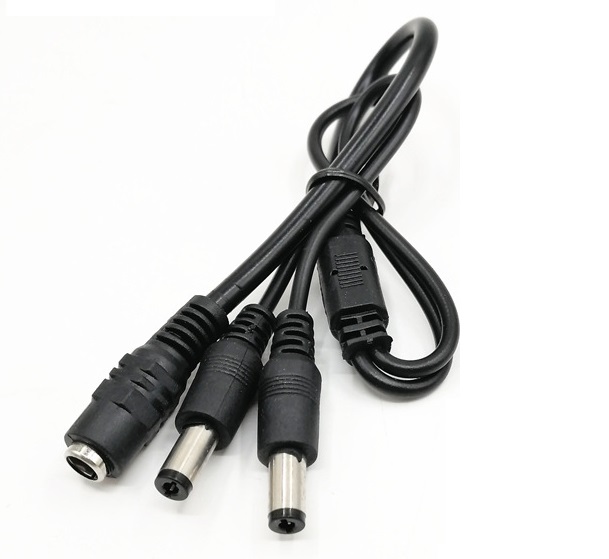
DC wire, in full form, is a direct current power line. It mainly transmits direct current. It is essential to strictly distinguish the positive and negative poles. This is the most fundamental and non-negotiable rule for direct current power supply. If the polarity is reversed, it can easily cause equipment damage, wire burning, and even safety hazards. Whether it is a finished DC power line, a customized DC connection line, or the internal wiring of the equipment, the polarity must not be confused.
From the perspective of electrical principles, alternating current has no distinction between positive and negative poles; it only has live wire and neutral wire, and the current flows bidirectionally alternately. On the other hand, direct current has a fixed and single-directional flow of current, with clear positive and negative poles. The DC cable is connected to the power adapter at one end and the electrical device at the other end. The adapter outputs a positive pole that outputs high-voltage direct current, and the negative pole serves as the circuit return. The internal components such as circuit boards, chips, capacitors, and motors are all designed according to the fixed current direction. Components like capacitors, diodes, and integrated circuits have polarity restrictions. Reverse connection will instantly break down the internal structure. Mildly, the device will go black screen and fail to start. Severe cases include the motherboard short-circuiting and burning out, the adapter overheating and catching fire, and the insulation skin of the wire melting and short-circuiting.
There is a unified polarity identification standard for DC cables on the market. The most common cylindrical DC plugs follow the inner positive and outer negative standard: the central metal core of the plug is the positive pole, and the outer metal sleeve is the negative pole. Most notebook computers, monitors, routers, LED light strips, and small household appliances' DC interfaces adopt this standard. A few industrial equipment and high-power battery devices will customize inner negative and outer positive plugs. Such cables will have obvious markings printed on the cable body, plug, and interface, and cannot be used with regular DC cables. The cables themselves will also be designed differently. The positive conductors are mostly printed with white stripes and dashed lines, while the negative conductors are pure black, making it easy for the naked eye to quickly distinguish. During mass production, the color of the cables will be used to strengthen the distinction, with red for positive and black for negative, which is the industry's common color combination.
In actual use and production processes, the distinction between positive and negative poles is maintained throughout the entire process. At the production stage, during the wire cutting and plug welding steps, workers must weld according to the markings. Quality inspection will use a multimeter to measure the polarity to prevent reverse-wired components from entering the market. During assembly, when soldering the DC socket to the main board, it is necessary to strictly correspond the positive and negative pole pads. When repairing or replacing DC cables, the two wires cannot be randomly swapped. When ordinary users use it, when replacing the DC adapter, extending the DC cable, or making homemade adapter circuits, they must check the polarity of the plug and the device markings. Only by matching the size cannot they be mixed. DC plugs with the same outer and inner diameters may have opposite polarities. Blindly plugging and unplugging will directly damage the equipment.
Many people have misconceptions, believing that reversing the connection of low-voltage and low-power DC devices has no effect. Small LED strips and monitoring systems with 5V or 12V seem to show no reaction during short-term power supply, but the internal components have already been subjected to reverse voltage. Over time, this will accelerate aging and shorten the lifespan of the equipment. For large-power 24V or 48V industrial DC devices, reversing the connection will immediately generate a large current, which will directly burn out the power supply and the load.
In conclusion, the DC line transmits direct current, with a fixed current direction. The positive and negative poles must be strictly distinguished. Whether in production and manufacturing, equipment maintenance, or daily use, the polarity must be confirmed through the color of the wire, the plug identification, and the multimeter. Prohibiting reverse connection operations is necessary to ensure the safe and stable operation of the wire materials and electrical equipment, and to avoid short circuits and other fault risks.
Contact: Jerry_Shi
Phone: +86-13652508770
Tel: +86-13652508770
Email: [email protected]
Add: LianFeng Road,XianXi Village,ChangAn Town,DongGuan City,GuangDong Province,China