
Home > News
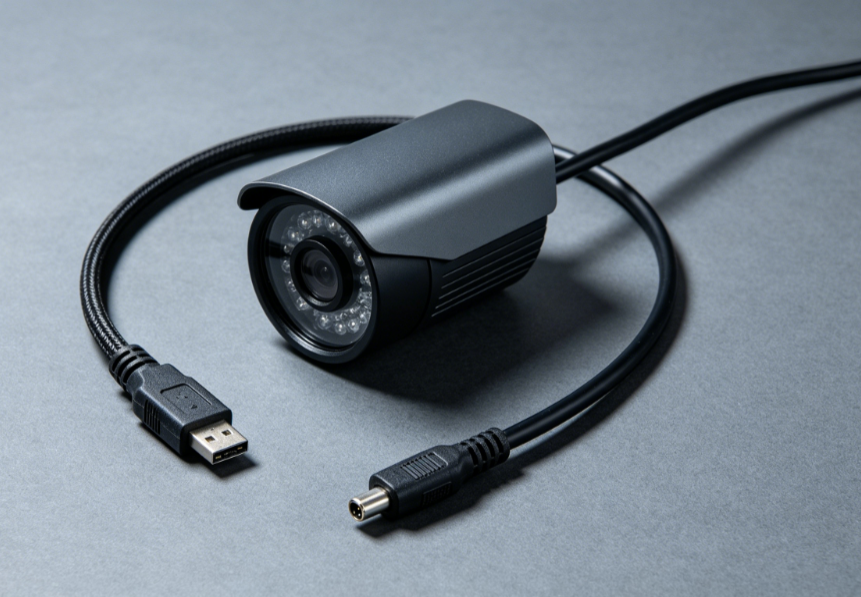
12V direct current power supply is the most commonly used power supply system for analog and network monitoring cameras. The selection of the wire diameter for the DC line is mainly determined by three factors: transmission distance, single-path power, and the number of parallel cameras. If the wire diameter is too thin, the voltage drop will be too high, causing the camera to go black, the infrared night vision to fail to start, and repeated restarts. If the wire diameter is too thick, it will increase the construction cost. It is necessary to select the appropriate wire diameter in accordance with the national standard for copper core cables.
The rated power of ordinary single-camera network cameras is usually between 3W and 5W. Under a 12V condition, the working current for each channel is approximately 0.25A to 0.4A. For devices with high-power infrared balls and zoom pan-tilt units, the power can reach 12W to 24W, with a working current of 1A to 2A. The wire diameter selection standards for these two types are completely different. The common specifications of DC cable used in surveillance are labeled in terms of square millimeters (mm²) and AWG wire gauge. The mainstream wire diameters for home surveillance are 0.3mm², 0.5mm², 0.75mm², and 1.0mm².
Close-range wiring (0 - 20 meters). For a single ordinary gun camera, 0.3mm² (24AWG) copper core DC sheathed wire is the preferred choice. For short-distance lines, the voltage loss is less than 0.5V. The terminal voltage of 12V can be stably maintained above 11.5V, meeting the rated working voltage requirements of the equipment. It is also the standard wiring material for the short lines of the finished DC plugs. It is mostly used in scenarios where power adapters are connected to cameras nearby. This wire has a fine and soft wire body and a low cost. It is not suitable for extending the distance or powering multiple circuits in parallel.
Medium-distance wiring (20 meters to 50 meters) uses a single independent power supply and uniformly selects 0.5mm² (22AWG) cables. This is the most common specification used in engineering monitoring. The 0.5 square copper wire has a low resistivity, and the voltage drop of a single power supply at 50 meters is controlled within 1V. Even if the infrared lights are turned on at full power at night, the voltage will not fall below 11V. If one main line is connected with 2 to 3 cameras, the total current is added together, and for a 50-meter distance, it must be upgraded to 0.5mm². The 0.3mm² long line parallel connection is prone to cause the night vision failure problem at night.
Long-distance wiring (50 meters to 100 meters), for a single camera, it is recommended to use 0.75mm² (20AWG) copper core wire. For wiring over 100 meters, 1.0mm² wire is preferred. The voltage drop of 12V low-voltage direct current increases exponentially with distance. Thin wires and long cables have severe copper loss and heat generation. A 0.5mm² cable with no load can still function, but when fully loaded with infrared activation, the terminal voltage often drops below 10V, preventing the equipment from starting normally. For large-power devices such as dome cameras and pan-tilt units, starting from 30 meters of wiring, 0.75mm² wire should be used.
The multi-path centralized power supply scenario is a challenging aspect of the selection process. One 12V centralized power supply can power 8 to 16 cameras. The main bus must be thickened. For a total power of less than 60W, the main bus uses 0.75mm²; for a total power of more than 100W, the main bus is upgraded to 1.0mm². Branches are connected to each camera and then further divided into 0.5mm² branch lines. The "thick main bus + thin branch" wiring method is adopted to balance cost and power supply stability. Aluminum wires must not be used for DC power supply in the monitoring system. For the same wire diameter, the voltage drop of aluminum wires is more than three times that of copper wires, and they are only used for temporary emergency purposes.
In addition, it is necessary to distinguish between pure copper and copper-clad aluminum wire. The nominal cross-sectional area of copper-clad aluminum is 0.5mm², but its actual electrical conductivity is only equivalent to that of pure copper (0.3mm²). When purchasing wire, it is essential to ensure that the material is of national standard oxygen-free copper. 12V DC belongs to low-voltage and weak current, and there is no risk of high-voltage electric shock. However, a short circuit between the positive and negative poles will cause immediate heating and fire. For concentrated power supply lines with thick wires, it is recommended to install a small fuse at the power supply end.
Summary: Within 20 meters, single-core wire with a diameter of 0.3mm²; within 20 to 50 meters, single-core wire with a diameter of 0.5mm²; within 50 to 100 meters, single-core wire with a diameter of 0.75 to 1.0mm². For dome cameras and centralized power supply systems, the wire diameter is uniformly increased by one grade based on distance and power selection, aiming to fundamentally prevent voltage deficiency faults.
Contact: Jerry_Shi
Phone: +86-13652508770
Tel: +86-13652508770
Email: [email protected]
Add: LianFeng Road,XianXi Village,ChangAn Town,DongGuan City,GuangDong Province,China