
Home > News
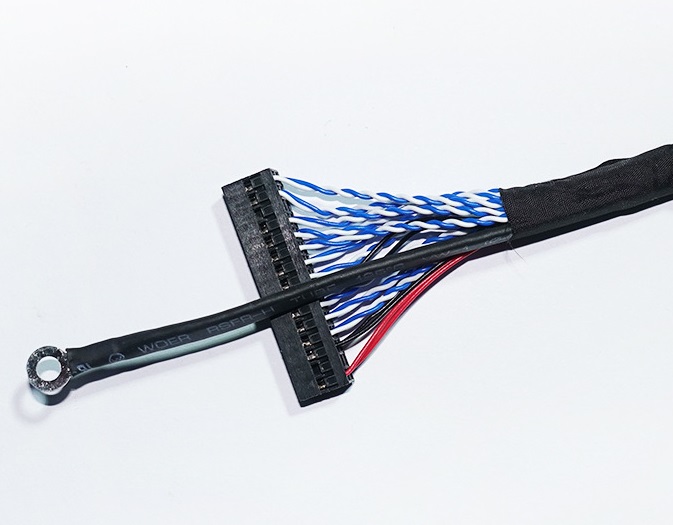
LVDS (Low Voltage Differential Signaling) technology is widely used in high-speed data transmission for displays, industrial control devices, and automotive electronic systems. Its transmission stability relies heavily on signal integrity, while poor cable performance, irregular wiring, and external interference often cause signal attenuation, crosstalk, and display anomalies such as screen flickering and color cast. To ensure long-term stable and high-efficiency data transmission, it is essential to adopt standardized and targeted measures to improve LVDS cable signal transmission quality. Multiple optimization methods covering cable selection, wiring design, environmental adaptation, and assembly processing can effectively enhance signal stability.
Selecting high-quality standard LVDS cables is the foundation of improving signal transmission quality. Qualified LVDS cables must maintain a precise 100-ohm differential impedance, which is the core standard for avoiding signal reflection and distortion. It is crucial to choose cables with tightly twisted differential pairs, as uniform twisting can greatly reduce internal crosstalk between signal lines. In terms of shielding structure, double-layer shielding with aluminum foil and braided copper mesh is far superior to single-layer shielding. This full-range shielding structure can effectively isolate external electromagnetic interference from power lines and mechanical equipment. In addition, thickened conductive cores and high-insulation sheath materials reduce signal resistance loss and aging failure, making them more suitable for long-term high-speed transmission scenarios.
Standardizing wiring and installation specifications is a key step to optimize signal quality. Many signal faults stem from irregular cable layout. First, LVDS signal cables must be laid separately from high-voltage power cables, motors, and high-frequency equipment, with a safe isolation distance to avoid electromagnetic coupling interference. Crossing or parallel winding of signal lines and power lines should be strictly avoided. Second, the cable bending radius must comply with industry standards; excessive bending, stretching, or extrusion will damage the internal twisted structure and shielding layer, destroying differential signal balance. Meanwhile, the cable length should be reasonably controlled. Under high transmission rates, overly long cables will cause cumulative signal attenuation, so the shortest possible wiring path should be adopted on the premise of meeting installation requirements.
Optimizing connection and grounding processing cannot be ignored for stable signal transmission. Poor grounding is one of the most common causes of LVDS signal noise. The cable shielding layer must achieve 360-degree full grounding at both ends of the connector to form a complete shielding loop and prevent signal leakage. Operators should ensure that connector pins are clean, intact, and free from oxidation, dust, or poor contact, which can cause intermittent signal transmission faults. For long-distance or high-speed transmission scenarios, installing professional LVDS repeaters and signal amplifiers can compensate for signal attenuation and restore complete data signals, significantly improving transmission stability.
Improving the operating environment and daily maintenance also helps sustain high signal quality. High temperature, humidity, and dust will accelerate cable aging and damage shielding performance. Keeping the equipment operating environment dry, clean, and well-ventilated can avoid insulation layer deterioration and metal pin oxidation. For industrial and vehicle-mounted equipment that faces long-term vibration, fixed cable wiring and shockproof protection can prevent interface looseness and internal wire core breakage. Regular inspection of cable aging, shielding damage, and poor grounding conditions allows timely replacement and maintenance to eliminate potential signal faults.
In conclusion, improving LVDS signal transmission quality requires systematic optimization from cable selection, standardized wiring, reliable grounding, and environmental maintenance. Scientific configuration and standardized operation can effectively reduce interference and signal loss, ensuring accurate, stable, and efficient long-term operation of LVDS transmission systems in various complex scenarios.
Contact: Jerry_Shi
Phone: +86-13652508770
Tel: +86-13652508770
Email: [email protected]
Add: LianFeng Road,XianXi Village,ChangAn Town,DongGuan City,GuangDong Province,China