
Home > News
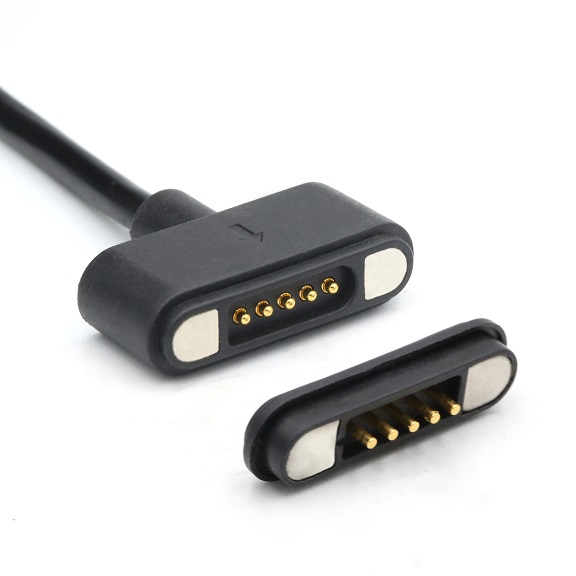
Magnetic data cables, also known as magnetic suction data cables, consist of three main parts: the magnetic suction connector terminal, the cable body, and the magnetic suction male connector. They achieve circuit conduction through magnetic attraction and simultaneously perform functions such as charging and data transmission. The overall working logic is divided into four steps: magnetic force docking, circuit conduction, signal and power transmission, and anti-detachment protection. Each part cooperates with each other to form a unique working system different from ordinary straight plug cables.
First, there is the magnetic attraction positioning stage, which is the most fundamental prerequisite for the magnetic wire. Both ends of the magnetic wire are embedded with neodymium iron boron strong magnets. These permanent magnets have strong magnetic force and are small in size. They are respectively encapsulated inside the magnetic attraction head of the cable and the device adapter plug, and are designed with polarity alignment. One end is the N pole and the other is the S pole. When they are close to each other, a directional attraction force will be generated. There is no need for manual precise alignment. They can automatically adhere and fit together within a distance of a few millimeters. The outer layer of the magnets is equipped with positioning plastic protrusions to prevent incorrect insertion (either facing up or down) which could cause contact short circuits. The attraction force has been standardized and adjusted. They will not fall off when placed casually or slightly dragged. When subjected to strong pulling, they can quickly separate. This protects the charging ports of devices such as mobile phones and tablets from physical damage caused by violent unplugging of the straight cable. The magnetic force alone is only responsible for physical adhesion. It does not conduct electricity itself. The internal metal contact array is what truly carries the current and signals.
The next is the working principle of the conductive contacts. After magnetic adhesion, the multiple spring pins (Pogo Pin) inside are compressed and contracted. The bottom of the pins connects to the internal wires of the cable, and the gold plating on the top tightly contacts the metal pads on the opposite adapter plug, forming a complete conductive circuit. The number of magnetic wire contacts varies depending on the different specifications. For the 2-pin style, there are only power positive and negative contact points, which can only transmit charging current; for the 6-pin, 8-pin, and 12-pin multi-contact models, the contacts are arranged in different zones, specifically dividing the power pins, D+D- data differential pins, fast charging identification pins, and video signal pins. The zone design can isolate the electromagnetic interference caused by large currents, preventing data transmission from being interfered with when the charging power is too high. The spring pins come with built-in elastic buffering, and even when the device shakes or moves slightly, they still maintain a tight contact, ensuring that the circuit does not suddenly disconnect. The gold plating can resist oxidation, reduce contact resistance, and minimize heat generation and voltage loss, maintaining stable charging and signal transmission.
The third aspect is the operation mechanism of synchronous power and data transmission. The current transmission path is simple and clear: The charger outputs current, which flows through the cable power line, magnetic suction contacts, and device interface into the battery for charging. The magnetic suction cable with an E-Marker chip will communicate with the device through dedicated identification contacts to negotiate fast charging voltages such as 5V, 9V, and 12V, enabling PD and QC high-power fast charging. Data transmission relies on independent differential signal lines. Ordinary USB2.0 magnetic cables use D+ and D- contacts to transfer low-speed data, which is used for photo copying and device backup; high-end multi-pin magnetic cable adds high-speed signal contacts and supports USB3.0 and higher transmission protocols, enabling high-speed reading and writing of hard drives and outputting video images. Magnets generate weak magnetic fields. Manufacturers will add aluminum foil and copper mesh double-layer shielding layers inside the cable, and add insulating layers between the contacts to cancel the interference of the magnetic field on the differential signal, avoiding transmission lag and file damage.
Finally, the safety protection mechanism operates synchronously. When the magnetic wire is in operation, it comes with multiple protective logic. When it adsorbs and misaligns, the positioning glue prevents the contact points from touching each other, eliminating the possibility of positive and negative poles short-circuiting. During high current transmission, the low-resistance design of the contact points reduces heat generation. Some magnetic suction heads are equipped with temperature control resistors, which automatically reduce power when the temperature is abnormal. When subjected to external force pulling, the magnetic suction quickly separates, immediately cutting off the circuit, preventing the wire from being pulled and tearing the device's tail plug. In the separated state, the exposed area of the adapter plug contact is small, making it less likely to be contaminated by dust and cause a short circuit. Daily cleaning only requires wiping the magnetic suction surface. Compared to ordinary connectors that are left plugged in the device for a long time, the failure rate is lower.
Overall, the magnetic cable does not rely on magnets for conductivity. The magnets only perform the functions of automatic alignment and preventing accidental separation. The power and data are transmitted through a complete circuit formed by gold-plated spring pins. The magnetic attraction simplifies the insertion and removal process. The multi-contact partition structure balances fast charging and data transmission. The shielding structure eliminates the signal interference caused by the magnets. The multiple protective structures enhance the safety of use. The entire structure works together, retaining the core functions of traditional data cables for charging and data transmission, while relying on the magnetic attachment structure to solve the problems of easily damaged straight plug cables and cumbersome insertion and removal. This is the core reason why magnetic connection cables are widely used in digital and industrial control equipment nowadays.
Contact: Jerry_Shi
Phone: +86-13652508770
Tel: +86-13652508770
Email: [email protected]
Add: LianFeng Road,XianXi Village,ChangAn Town,DongGuan City,GuangDong Province,China