
Home > News
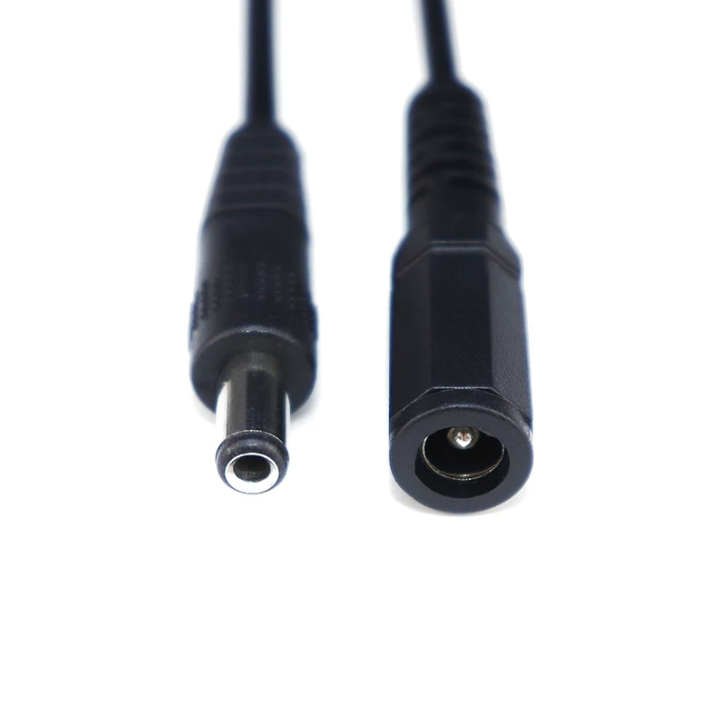
DC direct current power cables are widely used in routers, surveillance systems, laptop adapters, LED light strips, and various small household appliances. To quickly distinguish between male and female connectors, one can look at the external structure, the inner and outer cores, the installation and usage location, and the wiring rules. Once the features are mastered, one can easily distinguish them with the naked eye. How can I distinguish between the male and female ends of the DC cable connector?
From a physical perspective, the male connector protrudes outward while the female connector is recessed inward. This is the most fundamental distinguishing feature. A standard circular DC connector consists of an outer metal cylinder, an insulating rubber core in the middle, and a central metal pin. The front end of the male connector extends a solid or hollow metal cylindrical plug. The outer ring is a cylindrical metal shell, and the whole is raised, capable of being inserted into the female connector. The middle of the female connector is a hollow circular hole, and the outer ring is also wrapped with a metal sleeve. The whole is recessed inward, used to receive the plug pins from the male connector. Most of the output terminals of daily adapters are male connectors, and the power interfaces built into the device bodies are basically female connectors (female plugs).
According to the positions of the external and internal electrodes, the general specification of a conventional DC plug is an outer diameter of 5.5mm and an inner hole of 2.1mm/2.5mm. This is also the most common specification available on the market. Male plug: The central protruding pin = positive electrode, the outer metal cylinder = negative electrode; Female plug: The contact point on the inner wall of the middle circular hole is the positive electrode, and the outer metal sleeve is the negative electrode. By removing the plug's outer shell, the wiring can be clearly seen. The inner core of the male plug's power cord connects to the central pin, and the multi-strand copper wire is wound around the outer metal shell. The female socket's wiring is the opposite. The internal spring contact points connect to the positive lead wire, and the metal parts of the outer shell are connected to the negative wire. A few non-standard DC plugs have reversed electrodes, but the shape remains unchanged. Only the positive and negative electrode wirings are swapped.
Distinguishing by usage scenarios is the simplest practical method. The plugs connected to power adapters and mobile power banks are all DC female connectors, serving to output power externally; the built-in interfaces on the bodies of electrical devices such as routers, optical modems, cameras, desk lamps, and small water pumps are embedded and cannot be unplugged, and they are female connectors. There are also extension cables, with one end being male and the other end being female. The male end plugs into an adapter, and the female end is connected to the device to extend the power cord. Short-line adapters and DC elbows are handled in the same way, with the protruding end being male and the recessed end being female.
In addition to the circular DC sockets, there are also square and surface-mount DC sockets, which are logically consistent in distinction. The DC sockets with surface-mount soldering on the circuit board have a recessed socket for the female connector; the separate plug-in plugs and the protruding pins at the end of the wire bundle are for the male connector. When choosing accessories, if you want to connect two DC wires, use one male and one female; if the female socket of the equipment is damaged and you need to replace the accessory, purchase a DC female socket of the same specification; if the adapter is lost and you need to replace the wire, choose the corresponding size DC male power cord.
Daily simple identification mnemonic: Raised pins indicate male, recessed holes indicate female; Outgoing wires indicate male, body is female. Novices do not need to measure the dimensions; just by judging the shape of protrusions and depressions, they can quickly determine. When purchasing, apart from distinguishing between male and female, also check the outer diameter and inner hole dimensions to avoid mismatched sizes that prevent insertion. DC female socket; If the adapter is lost and a wire needs to be replaced, select the corresponding size DC male connector power cord.
Contact: Jerry_Shi
Phone: +86-13652508770
Tel: +86-13652508770
Email: [email protected]
Add: LianFeng Road,XianXi Village,ChangAn Town,DongGuan City,GuangDong Province,China