Do magnetic charging cables support fast charging?
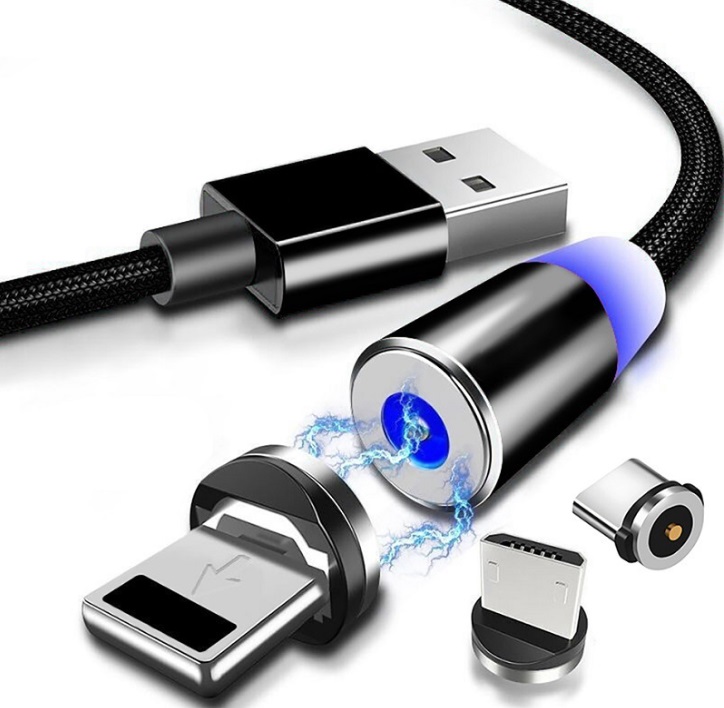
Can the magnetic charging cable provide fast charging? There are three scenarios to consider. The key lies in "magnetic connector protocol + cable specifications".
1. The key criterion for determining whether fast charging is possible
Common 2-pin magnetic suction (old-fashioned magnetic suction, cheap toys / small fan magnetic suction)
It only has 2 contact points for positive and negative poles, without data or fast charging identification pins. It only supports 5V1A/5V2A slow charging, and does not support fast charging at all. The maximum power is within 10W.The lowest-end two-contact magnetic connection only has positive and negative power supply contacts, lacking the CC pin for fast charging identification and the D+/D - contacts for data transmission. It is unable to establish fast charging handshake communication with the charger and the phone. The essence of fast charging is that devices negotiate voltage and current levels through signals. The two-contact magnetic connection lacks a signal transmission channel. The device can only default to the 5V basic charging mode, with output power generally ranging from 5W to 10W. It is only suitable for low-power small devices such as Bluetooth headphones, smart wristbands, and small portable fans, and is completely unable to provide fast charging for phones and tablets.
Multi-contact magnetic attachment (6/8/12-pin mobile phone magnetic attachment, magnetic PD fast charging head)
Additional CC identification pins, D+D - data pins are added, which can transmit fast charging signals and support fast charging protocols such as PD, QC, SCP, VOOC, etc. The maximum fast charging power can reach 60W, 100W, 120W.The eight-pin and twelve-pin full-function magnetic connectors serve as the core carriers for fast charging. Besides the positive and negative poles and data pins, separate CC fast charging identification contacts are reserved. Some high-power magnetic connectors also add ground wires and power detection contacts, enabling the complete transmission of mainstream fast charging protocol signals such as PD, QC, SCP, and VOOC. They support 5A current transmission and allow the phone to negotiate the high-voltage fast charging level with the fast charging adapter. The maximum power capacity can reach 100W, equivalent to that of a notebook-level fast charger.
2. Diameter of wire core
High-current fast charging requires thick copper wires:
Fine aluminum core thin wires: Can only provide 5V 2A slow charging;
22AWG/20AWG thick pure copper wires: Can carry 3A/5A high current, suitable for high-voltage fast charging.Fast charging requires continuous high current output. The low-voltage high-current fast charging solution (such as 11V6A, 10V4A) has extremely high requirements for the conductivity of the wire. Cheap magnetic suction cables use fine aluminum wires or 24AWG thin copper cores, which have high resistance. Under high current conditions, they will generate severe overheating and voltage loss, causing the charger to automatically reduce power to protect the circuit, and the fast charging will directly fail. Qualified fast charging magnetic suction cables uniformly use 22AWG, 20AWG thick pure copper multi-strand wire cores, combined with multi-layer shielding layers to reduce resistance and signal interference. They can stably carry 3A to 5A continuous current, meeting the electrical conductivity requirements for high-power fast charging, and at the same time reducing the overheating problem of the magnetic suction connectors.
3. Connector Compatibility Restrictions
The compatibility of the entire charging equipment also affects the fast charging effect. The magnetic connection is merely a transfer connector. All three components are indispensable: the fast charging charging head, the all-function fast charging magnetic cable, and the device that supports the corresponding fast charging protocol. Even if the magnetic cable meets the specification standards, when paired with a common 5V2A charging head, it can still only charge slowly; if the magnetic connector supports PD fast charging, but the phone only supports a proprietary super-fast charging protocol, it will also be unable to reach the maximum power. At the same time, the magnetic connector has physical wear and tear. The metal contacts will gradually oxidize and the gap will increase over time, resulting in contact resistance. Under the same conditions, the charging speed will be 5% to 15% slower than when using the direct plug-in original cable. This is a normal loss. Poor-quality magnetic contact points have a thinner coating and oxidize faster. Within a short period of time, they will completely lose the fast charging function.
II. Common Magnetic Adsorption Classification Fast Charging Capabilities
1. Circular magnetic attachment (old-fashioned Android 2-pin magnetic attachment)
Does not support fast charging, only 5V slow charging. Suitable for headphones, smartwatches, and small lamps.
2. Universal magnetic attachment for mobile phones (Type-C magnetic head)
8-pin / 12-pin models with CC fast charging identification, support 20W PD, 66W super fast charging;
The cheaper 4-pin model without identification pins, with a maximum of 18W ordinary charging.
3. MagSafe Apple magnetic attachment (iPhone-specific)
Original MagSafe: Maximum 15W magnetic fast charging;
Third-party compatible magnetic charging: Regular 7.5W~15W, does not support higher power.
4. Large-power magnetic attachment for laptops (100W PD magnetic attachment)
12-pin full-function magnetic attachment, supports 65W/100W PD fast charging, suitable for lightweight laptops and tablets.
III. Key Points for Selecting Safe Options
1.If you want to buy a fast charger, make sure the product page indicates: PD/QC/SCP, 5A high current, full-function 8/12-pin magnetic suction; only stating "magnetic charging" without any protocol = slow charging.
2.2 Magnetic suction devices do not support fast charging at all;
3. The magnetic suction connector will slightly reduce power output. Under the same power level, it will be slightly slower than the direct plug-in cable, which is a normal phenomenon;
4. Poor-quality magnetic suction contacts with poor contact will repeatedly cause power interruption and overheating. This not only makes the fast charging ineffective but also damages the battery.
Overall, when choosing a fast-charging magnetic cable, one should not only focus on the appearance and magnetic attachment design. It is necessary to confirm that the product is equipped with full contacts, supports a 5A high current, and is compatible with the corresponding fast charging protocol. Avoid choosing the simple two-pin thin cable products. Although magnetic fast charging is convenient, there are inherent shortcomings such as contact loss and slight power reduction. For full-speed fast charging, it is better to use the direct plug-in original cable. In daily commuting and vehicle usage scenarios, for the convenience of plugging and unplugging, one can choose to use the regular multi-contact fast-charging magnetic cable.