
Home > News
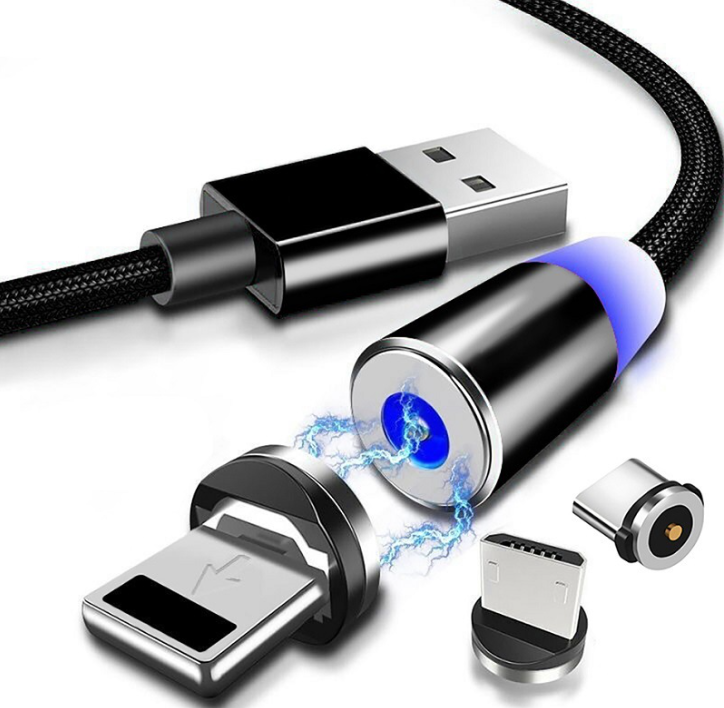
Magnetic charging cable have become a popular choice among digital accessories due to their convenient plug-and-charge design and ability to avoid interface damage during insertion and removal. However, their safety has long been controversial. This analysis evaluates the pros and cons from five key dimensions—electrical performance, physical structure, usage environment, long-term wear, and compatibility—to provide an objective assessment of potential risks.
The charging conduction of magnetic suction cables relies on exposed metal suction contacts, which is the biggest safety flaw compared to ordinary data cables. The metal contacts of standard Type-C and Lightning interfaces are embedded within the casing, making it difficult for foreign objects to directly contact the conductive area; while the metal contacts of the magnetic suction male and female heads are completely exposed. If a coin, paperclip, key, or metal debris simultaneously rests on the positive or negative pole contacts, it will instantly cause a short circuit. A minor short circuit can damage the phone's charging IC and charger, while a severe one can cause the charger to overheat, the outer casing to melt, and even cause a fire with inferior cables.
Regular magnetic suction cables have short-circuit protection resistors and temperature control chips built into the magnetic suction module. After a short circuit, they automatically cut off the current, and power supply is stopped when the temperature exceeds 60℃. Cheap unprotected magnetic suction cables lack protective circuits, and after a short circuit, they continue to output a large current, posing extremely high risks. At the same time, there is a contact resistance problem with the magnetic suction contacts. The magnetic gap and metal oxidation will increase the resistance, causing continuous heating during charging. Long-term high temperature will accelerate the aging of the copper wire insulation layer inside the cable, leading to leakage risks. In high-power fast charging scenarios, this problem is more prominent. For fast charging above 100W, it is not recommended to use low-priced magnetic suction cables.
On the advantage side, the magnetic attachment structure can significantly protect the charging interface of the device. Frequent insertion and removal of mobile phones and tablets can wear out the interface pins, causing poor contact and intermittent charging. With magnetic attachment, there is no loss during insertion and removal, significantly extending the lifespan of the tail plug of the device and avoiding the risk of pulling the wire and tearing the internal circuits of the device. The magnetic separation design has an overload release feature, and if the wire is accidentally pulled during charging, the magnetic head will directly disconnect, preventing the device from falling and getting damaged. This design is suitable for expensive digital devices such as mobile phones, tablets, and laptops.
The drawback is that the magnetic detachable structure has poor sealing performance. The original charging interface has a rubber ring for dust and water protection. The magnetic female head is exposed in the charging port for a long time, and dust and moisture can easily enter the device interior. During daily activities, sweat, water vapor on the hands, and accumulated cotton fibers in the pockets can accumulate at the magnetic contact points, causing oxidation of the contact points and intermittent charging. In severe cases, water vapor can seep into the device and corrode the motherboard components. Additionally, the magnetic force strength is a key隐患. If the magnetic force is too strong, it can interfere with the internal compass, wireless charging coil, and camera shake module of the mobile phone, causing the compass to deviate and the wireless charging to fail. If the magnetic force is too weak, it is prone to detachment and charging interruption.
The magnetic wire is less risky to use in a dry environment, but in special conditions, the safety hazards will multiply. In high-humidity environments such as kitchens, bathrooms, and outdoor rainy areas, water vapor adheres to the exposed metal contacts, causing weak electrical leakage. When hands are wet and touch the contacts, there is a numb sensation. The electrochemical corrosion caused by water vapor will quickly rust the contacts, causing the contact resistance to continuously increase and the charging to heat up more severely.
In high-temperature scenarios such as being exposed to the sun in a car during summer or charging close to a bed, the heat dissipation ability of the magnetic module in the integrated data cable is weak. The heat cannot be quickly dissipated, and the combination of high temperature and contact oxidation is likely to cause bulging and softening of the wire. Charging on the bed with a magnetic wire is riskier than using a regular data cable. If a foreign metal object falls onto the magnetic contact point and causes a short circuit, flammable materials such as bedding are highly likely to catch fire. In low-temperature environments, the magnetic metal contacts are prone to condensation, which can also trigger short-circuit faults.
After long-term use, the safety performance of the magnetic connection cable will continue to decline. The repeated adsorption and friction of the metal contacts will cause wear on the coating layer, exposing the underlying copper material and leading to oxidation. The charging temperature will significantly increase. Ordinary integrated data cables have a much longer lifespan in terms of bending resistance compared to the split magnetic connection structure.
In terms of battery health, inferior magnetic connection cables have severe voltage drop, unable to stably transmit the rated voltage of the charger. The mobile phone battery remains in a state of voltage fluctuation, and long-term fast charging will accelerate battery degradation and bulging. Qualified magnetic connection cables are equipped with a voltage stabilizing chip, with voltage loss controlled within 0.3V, causing no significant harm to the battery.
Overall, magnetic cables are not inherently unsafe. The risks are entirely determined by the product's construction and usage habits. Regular brand magnetic cables with temperature control, short-circuit protection, gold-plated and thickened contacts have similar safety levels to ordinary data cables in dry environments and can protect the device interfaces. Without any protection, three-no magnetic cables have a very high probability of short circuits, fires, and damage to digital devices. They are not recommended for purchase.
When using, avoid metal debris and humid environments. When charging on the bed, try to remove the magnetic head. For high-power fast charging, priority should be given to using integrated original cables. This can minimize the safety defects caused by the magnetic structure. In general, properly selected and properly used magnetic cables are safe accessories. Blindly purchasing at low prices and ignoring the usage environment will introduce multiple safety hazards.
Contact: Jerry_Shi
Phone: +86-13652508770
Tel: +86-13652508770
Email: [email protected]
Add: LianFeng Road,XianXi Village,ChangAn Town,DongGuan City,GuangDong Province,China